
Choosing between powder detergent and liquid detergent comes down to balancing washing efficiency, fabric compatibility, and environmental impact. The two formats have coexisted for decades, but their performances diverge on specific criteria that most comparisons overlook. Water temperature, type of stain, washing machine buildup, microfiber emission: each parameter guides the choice in a different direction.
Comparison Table: Powder vs. Liquid on Washing Criteria
| Criterion | Powder Detergent | Liquid Detergent |
|---|---|---|
| Effectiveness on white stains (coffee, wine, grass) | Superior due to bleaching agents | Acceptable, but without integrated bleaching action |
| Washing at low temperatures | Risk of undissolved residues | Complete dissolution, even in cold water |
| Delicate fabrics and dark colors | May dull colors | Better preserves shades |
| Washing machine buildup | Possible limescale deposits in case of overdosing | Fewer visible residues, but risk of greasy biofilm |
| Packaging and recyclability | Cardboard is more easily recyclable | Plastic bottle, variable recycling stream |
| Cost per washing cycle | Generally more economical | Often higher dosage |
This table summarizes the discrepancies observed in tests published by organizations like Que Choisir. The choice between powder or liquid detergent primarily depends on the dominant washing program in the household and the type of laundry being treated.

Dissolution and Temperature: The Parameter Most Households Overlook
The rise of low-temperature cycles (30 or 40 °C) has reshuffled the deck. Powder detergent was formulated for hot washes, where heat helps dissolve the granules. Below 40 °C, powder residues may remain trapped in the fibers or in the detergent drawer.
Liquid detergent dissolves upon contact with water, regardless of temperature. For households that wash most of their laundry at 30 °C, this point becomes crucial.
Consequences on Washing Machine Buildup
Undissolved powder residues accumulate in the drum, seals, and pipes. Over time, they form a limescale deposit that promotes unpleasant odors. Que Choisir points to overdosing as an aggravating factor: most users pour too much product, regardless of the format.
Liquid detergent is not without its criticisms. Its greasy texture leaves a film on the internal walls of the washing machine, conducive to mold growth. A monthly empty cycle at 60 °C remains the most effective remedy for both formats.
Microfiber Emission: A Criterion Absent from Labels
Synthetic textiles release plastic microfibers with every wash cycle. These particles pass through wastewater treatment plant filters and end up in water bodies. The type of detergent used directly influences this phenomenon.
Recent campaigns from cleaning product manufacturers quantify a reduction of up to -70% of microfibers released into the water when adapting the detergent and washing parameters. The combination of low temperature, moderate spin, and gentle liquid detergent seems to limit the mechanical abrasion of synthetic fibers.
Powder detergent, on the other hand, sometimes contains abrasive particles that increase friction on fabrics. On polyester or nylon garments, this mechanical effect accelerates the release of microfibers.
- Choosing a liquid detergent for synthetic textiles reduces abrasion and the dispersion of microfibers in wastewater.
- Lowering the temperature and spin speed enhances this protective effect, regardless of the detergent format.
- Microfiber filters for washing machines (washing bags or external filters) complement the action of the detergent without replacing it.
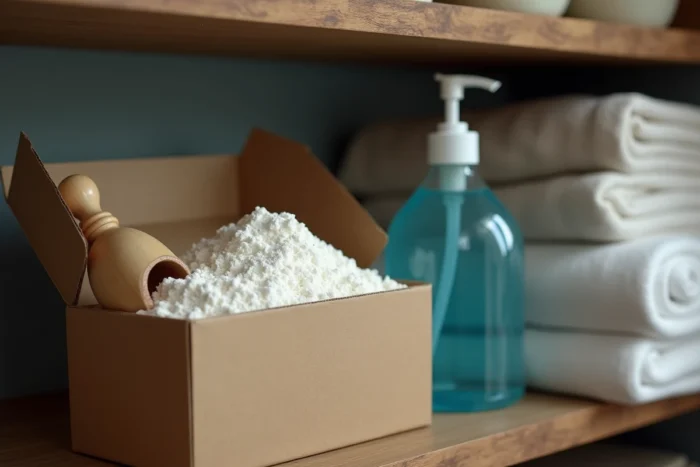
Recyclability of Packaging: Cardboard vs. Plastic
The environmental debate is not limited to the product formula. The cardboard packaging of powder is recyclable in the paper stream, which is widely implemented in France. The plastic bottle of liquid detergent, however, depends on the rigid plastic stream, whose effective recycling rate varies by locality.
Some brands now offer soft refills or concentrates to dilute to reduce plastic volume. These hybrid formats blur the classic boundary between powder and liquid, providing an interesting compromise in terms of waste generated.
Gray Water and Detergent Choice: A Recent Regulatory Framework
A decree and an order from July 12, 2024, have opened a experimental framework for the reuse of gray water for domestic purposes in France, including laundry. This system, valid until 2034, imposes strict sanitary conditions: separation of networks, prior declaration, regular control.
For homes equipped with such systems, the choice of detergent takes on an additional dimension. Concentrated liquid detergents, with fewer mineral fillers, generate gray water that is easier to treat. Classic powder, rich in alkaline agents, can disrupt the functioning of biological filtration systems.
Choice Criteria Based on Household Washing Profile
Rather than designating a universally superior format, cross-referencing the dominant type of laundry with washing habits allows for a rational choice.
- White laundry and frequent organic stains: powder remains more effective due to its bleaching agents active from 40 °C.
- Colored and synthetic textiles washed at low temperatures: liquid detergent preserves colors and limits residues.
- Households sensitive to allergens: powder detergents without fragrance or liquid preservatives generally present less risk of skin irritation.
- Homes equipped with a gray water reuse system: favor a concentrated liquid formula, low in mineral fillers.
The capsule format, a pre-measured variant of liquid detergent, eliminates the problem of overdosing but remains more expensive per cycle. Its main advantage lies in the consistency of dosing for newer machines, which adjust water consumption based on laundry weight.
The choice between powder and liquid does not have a single answer. The most structuring factor remains the household’s usual washing temperature: below 40 °C, liquid prevails due to its dissolution; above, powder regains the advantage on stubborn stains and cost per cycle.