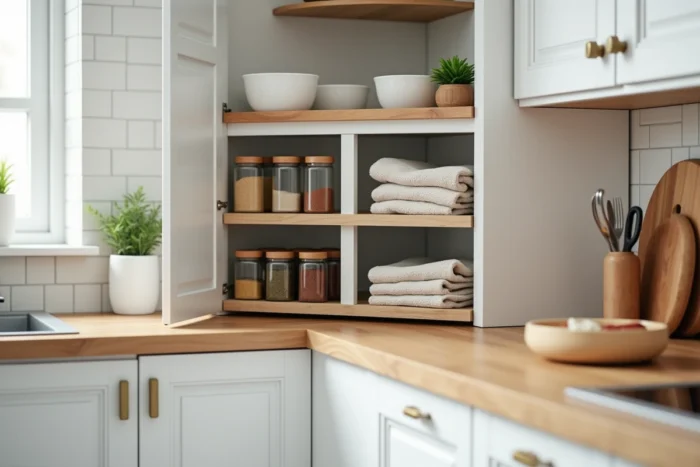
In a kitchen of less than seven square meters, corners often represent the most underutilized area. Walls that meet, hard-to-reach corner cabinets, lost nooks behind appliances: these spaces, when combined, can offer a significant storage volume. Optimizing the corners of a small kitchen requires understanding the geometric constraints specific to each configuration before choosing an appropriate storage system.
Geometry of Corners in the Kitchen: What the Configuration Imposes
Not all kitchen corners are created equal. A 90° angle between two linear sections in an L shape does not pose the same problems as a dead corner under a U-shaped countertop. In the first case, the depth of the corner cabinet is often inaccessible without a rotating mechanism. In the second, the circulation dictates what can be installed there.
Most articles on the subject recommend lazy Susans or sliding baskets. These solutions work, but they do not solve everything. A standard lazy Susan leaves a residual space between the circle it describes and the square walls of the cabinet. Depending on the depth of the furniture, this loss can represent a significant portion of the total volume.
Corner hardware with pull-out trays (like Le Mans or magic corner) offers a significantly higher volume utilization rate. Their principle: two independent trays pivot and come out of the cabinet one after the other, providing access to almost the entire depth. The additional cost compared to a simple lazy Susan is real, but the gain in accessibility justifies the investment in a kitchen where every liter of storage counts.
To delve deeper into the question of corner furniture and discover more storage tips on Angie Sweet Home, the logic remains the same: adapt the system to the actual available volume rather than applying a generic solution.
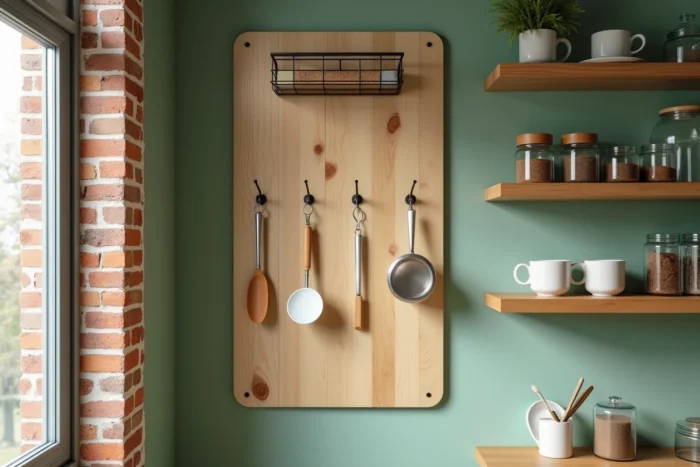
High Corner Storage: Open Shelves or Closed Cabinets
Vertical space in corners is rarely utilized beyond the first high cabinet. The angles between the tops of cabinets and the ceiling, or between two walls without furniture, are potential storage areas for rarely used items.
Open Corner Shelves
One or two triangular shelves fixed in a free wall corner can hold jars, spices, or small utensils. The advantage is the immediate visibility of the contents. The downside, in a kitchen, is exposure to grease and moisture. Open shelves work better away from the cooking area.
High Corner Cabinets
A high corner cabinet with a folding or lift-up door offers a closed and protected volume. The difficulty lies in access: at more than one meter seventy in height, items stored at the back become hard to reach without a step stool. Reserving high corners for seasonal or rarely used items (raclette machine, specific cake molds) remains the most functional strategy.
Lost Corners Under Countertops: Retractable Solutions and Mobile Modules
The trend towards retractable and transformable kitchens, identified as one of the significant developments for small urban spaces according to Archiproducts, opens concrete avenues for the corners under countertops. The idea is no longer just to store in the corner, but to make the storage disappear when not in use.
An angle block on wheels, for example, can serve as a mobile serving cart when cooking and slide into the corner once folded. Some models incorporate a drop-leaf countertop that temporarily enlarges the preparation area. This approach requires a sufficiently clear angle and a level floor, which is not guaranteed in all older homes.
Another option: narrow corner columns with internal drawers. Their small width (often less than thirty centimeters in front) makes them suitable for residual spaces between a built-in oven and a wall. Typical contents: dish towels, cling film, cutting boards stored vertically.
- Mobile corner block on wheels: suitable for L-shaped kitchens where the angle remains open, it combines storage and additional surface
- Narrow corner column with drawers: utilizes gaps of a few centimeters between furniture and wall, ideal for vertical storage
- Drop-leaf countertop fixed in the corner: frees up the surface at rest and creates a temporary preparation station
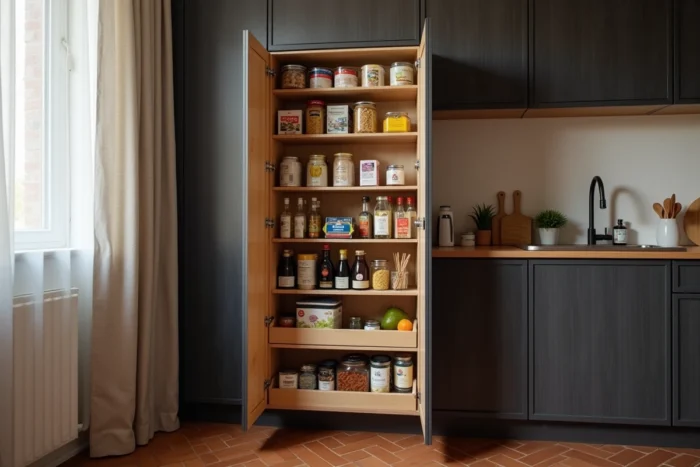
Corner Backsplash and Magnetic Accessories: Utilizing Walls Without Drilling Everywhere
The two walls that form a kitchen corner offer a vertical surface that is often bare. Installing a functional backsplash in this area allows for the attachment of accessories without encroaching on the countertop.
Magnetic knife bars, rails with hanging hooks, and small suction cup or adhesive baskets transform a corner wall into a storage area accessible at hand height. The point of caution concerns weight: adhesive systems rarely support more than a few kilograms, and a wall corner exposed to cooking steam sees their adhesion decrease over time.
Perforated backsplashes (like pegboards) provide a more robust alternative. Fixed by two or three screw points, they accept modular configurations: hooks, shelves, hanging pots. An angle pegboard covers two walls with a single system, reducing the number of fixings and visually unifying the space.
The choice of material matters. Stainless steel or lacquered steel withstands the kitchen environment better than raw wood, which absorbs splashes and deforms near the sink or stove.
- Corner magnetic bar: frees up an entire drawer by moving knives to the wall
- Metal pegboard: modular, it adapts to evolving needs without new fixings
- Stainless steel hook rail: suspended under a high corner cabinet, it holds mugs, spatulas, or small pots
Optimizing the corners of a small kitchen is less about accumulating accessories than about a precise reading of the available volumes. Each corner has its own geometry that dictates the relevant type of storage. Pull-out hardware for deep cabinets, mobile modules for open corners, wall solutions for vertical surfaces: the right system is the one that corresponds to the actual constraints of the space, not the one that looks the cleverest in a photo.