
When collecting a new passport at the town hall, you are asked to return the old one. Many travelers instinctively want to keep it, if only for the stamps accumulated over the years. The question of whether to keep one’s old French passport then arises, between strict regulatory framework and actual leeway at the counter.
Administrative cancellation of the passport: what really happens at the counter
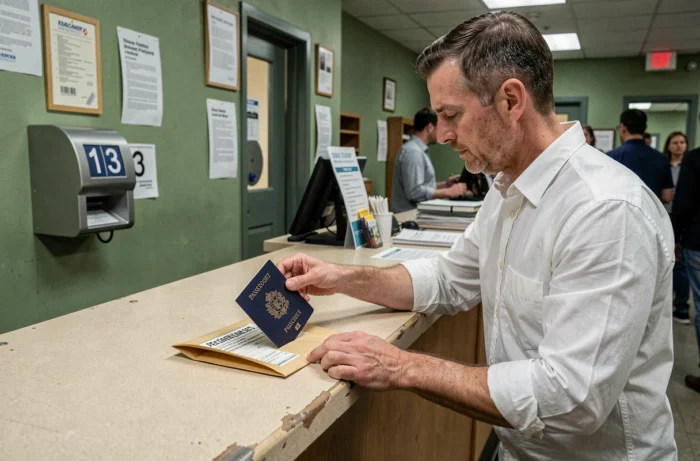
It is often assumed that returning the old passport is a mere formality. In reality, the old passport is systematically canceled by the administration when the new document is collected. The agent at the town hall perforates or cuts a corner of the document to render it unusable as an identity document.
This cancellation is not optional. It aims to prevent the simultaneous circulation of two valid passports in the name of the same person, which would pose a risk of identity theft.
The regulations distinguish between cancellation and retention. Once the passport is invalidated (punched, corners cut), some counters accept to return it to you. Returns vary on this point depending on the town halls, but the practice does exist. To better understand the subtleties of this process, refer to this article on keeping your old French passport.
Expired passport kept at home: practical use beyond nostalgia
Keeping an old passport is not just about nostalgia for the stamps. An expired passport that is less than five years old can still serve as proof of French nationality during a renewal. This avoids the need to provide other civil status documents, simplifying the process.
Another direct use case: still valid visas. Some countries issue multiple-entry visas that last longer than the passport. Keeping the old document with the visa allows for travel by presenting both passports (the old one with the visa, the new one for entry into the territory).
What an canceled passport no longer allows
- Crossing a border as an identity document, even within the European area. The perforation renders it invalid for any checks.
- Proving one’s identity to a bank or notary. Only a valid document is acceptable.
- Serving as a second passport for travel. France allows a second passport in very specific cases (professional reasons, visa incompatibility), but it must be an active document, not an expired one.
Early renewal and declaration of loss: pitfalls to avoid
You can submit a renewal request without waiting for the passport to expire. A valid passport or one expired for less than five years is sufficient to initiate the procedure. Waiting until the last minute before a trip exposes you to the risk of being without a valid document during the processing time.
If the old passport has been lost or stolen, the situation becomes more complicated. It is not enough to mention the disappearance at the counter. A declaration of loss or theft is mandatory, and this document replaces the presentation of the old title when collecting the new one.
Consequences of not returning an old passport without declaration
Not presenting the old passport when collecting the new one, without an official declaration of loss or theft, can trigger a specific process. The administration then applies enhanced control at the counter, which prolongs the procedure and may generate additional checks.
In short, it is better to produce the declaration in advance rather than arriving empty-handed hoping it will be accepted.

Passport stamps and souvenir pages: what the law really allows
The temptation to tear out pages to keep the stamps regularly circulates on social media. This is a very bad idea. Damaging a passport, even an expired one, remains an infringement of an official document. The pages contain biometric data and security elements that belong to the state.
The legal solution is simple: request the return of the entire passport after cancellation. If the agent agrees (which depends on local policy), you can retrieve the complete document, perforated but intact, with all its stamps.
Alternatives to keep a record of your travels
- Photograph or scan each stamped page before renewal. A high-resolution scan preserves the memory without touching the document.
- Explicitly request the return of the canceled passport at the time of collecting the new title. Formulating the request in advance allows the agent to prepare the procedure.
- Keep the canceled old passports in a safe place, away from active documents, to avoid any confusion during a check or administrative process.
An annulled passport stored in a drawer poses no legal problem. What poses a problem is a passport not returned, whose fate is unknown to the administration. The difference lies in traceability: as long as the document is officially invalidated in the system, its physical retention is a personal choice.