
Aleph Zarro is not structured like a traditional online magazine. The absence of fixed thematic sections (culture, tech, lifestyle) in favor of a logic of methodological guides applied to heterogeneous topics changes the game in terms of content architecture. Here, we analyze the technical and editorial choices that underpin this organization.
Aleph Zarro’s Cross-Editorial Architecture: A Model Without Fixed Sections
Most practical content sites rely on a vertical division by theme. Aleph Zarro adopts an opposite approach: each article applies an analytical framework or decision-making method to a given topic, whether it’s the rules of the card game crapette, choosing an aesthetician’s blouse, or an outing in Toulouse.
This “meta” positioning implies that navigation does not go through hermetic categories. The reader is not looking for a section on “card games” or “professional fashion”: they arrive at a self-contained guide that stands on its own. The site’s structure reflects this logic, with flat URLs and titles oriented towards user queries rather than internal taxonomy.
We recommend consulting the Aleph Zarro site structure to concretely visualize this absence of thematic hierarchy and the distribution of content by publication date rather than by category.
Sitemap and Internal Linking: How the Site Organizes Its Content Without Taxonomy
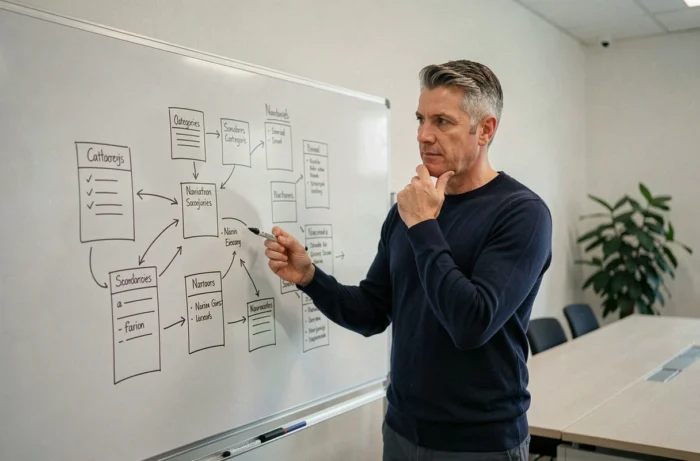
An XML sitemap primarily serves indexing robots. On a site without deep categorical structure, it also becomes a tool for editorial diagnostics. At Aleph Zarro, the sitemap exposes a flat structure where each piece of content occupies the same hierarchical level.
This choice has direct consequences on internal linking. Without category pages to redistribute link juice, the coherence of the linking relies entirely on contextual links inserted within the body of the articles. Each guide points to another guide sharing a common methodological axis, not a common theme.
An article on mirror hours can thus link to an article on personal development practices, not because they share a “well-being” section, but because the proposed analytical approach follows a similar logic. This type of affinity-based linking rather than thematic siloing remains rare in the ecosystem of French-speaking content sites.
Technical Consequences on Indexing
Without intermediate categories, Google indexes content pages directly. The absence of listing pages (like /category/games/ or /category/fashion/) removes a layer of low-value pages that often dilute crawl budget on small sites.
In return, each article must carry its thematic authority alone. It does not inherit any signals from a parent category. The quality of title tags, meta descriptions, and internal semantic markup becomes the main lever for positioning.
Content Formats and User Search Logic on Aleph Zarro
The articles published on Aleph Zarro share a recognizable editorial pattern: a long title oriented towards search intent, a structure in subsections that breaks down a process or choice, and writing that assumes a reader already engaged in an active approach.
We observe several recurring formats:
- The decision guide, which helps to decide between several concrete options (which equipment to choose, which game rule to apply). These articles target specific transactional or informational queries.
- The local exploration article, like the outing guides in Toulouse, which compile recommendations filtered by a practical criterion (immediate availability, budget, accessibility).
- The cultural or symbolic analysis, applied to topics like mirror hours or the Spider-Man universe, where the method consists of confronting sources and proposing a structured reading.
This thematic diversity, held together by a coherence of format, produces an atypical editorial profile. The common thread is not the subject matter but the methodological promise: no longer wasting time searching, understanding a rule, making an informed choice.
Title Optimization for Search
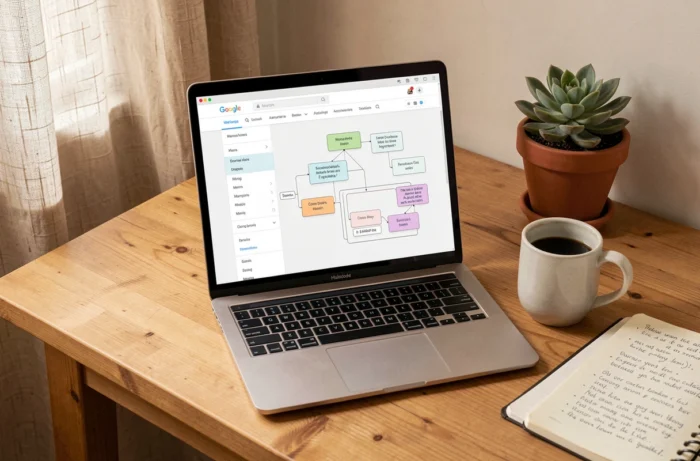
Article titles systematically incorporate a reformulation of the target query. “Crapette game rule: the easy method to avoid mistakes” or “Aesthetician’s blouse: a technical and strategic choice for the institute” leave no ambiguity about the covered intent.
This work on titles compensates for the absence of category pages. Where a classic site capitalizes on a page /professional-blouses/ that aggregates several articles, Aleph Zarro concentrates all semantic relevance in the title and content of the single article.
Platform and Technical Tools Behind the Aleph Zarro Site
An examination of the source code and publishing practices suggests a technical stack oriented towards simplicity. The site runs on a standard CMS with a theme optimized for reading performance. No community features, no user accounts, no personalized sessions: the site serves static or quasi-static content.
This technical minimalism directly supports loading speed and mobile compatibility. For a site whose traffic relies on organic search, reducing page rendering time remains a measurable positioning lever.
The absence of collected personal data (no visible registration form, no session cookies) also simplifies regulatory compliance. A practical content site that does not monetize through subscriptions or user data can afford this lightness.
Publication Frequency and Editorial Management
The publication dates of articles cover a wide range, indicating a regular but not intensive publication rhythm. The strategy prioritizes the depth of each guide over volume. An article on crapette or outings in Toulouse represents a heavier editorial investment than a news post, but generates traffic over a much longer duration.
This model of methodological “evergreen” content, published at a moderate pace on a flat architecture without categories, constitutes a coherent organizational choice for a site that bets on long-tail traffic and direct responses to user queries.