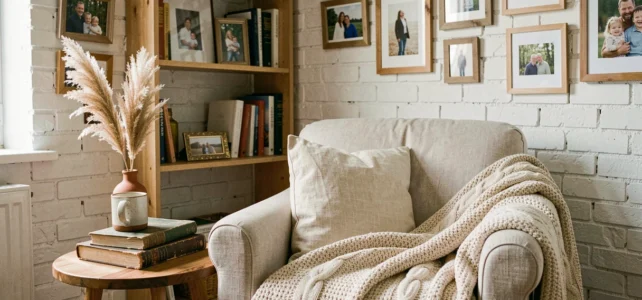
A warm interior does not rely on the accumulation of decorative objects, but on the coherence between materials, light, and volumes. We observe that the most successful home decoration projects start from a precise technical base before adding any personal touch.
Cloud Dancer and earthy palette: building a coherent room background
Pantone 2026, Cloud Dancer (11-4201), changes the classic approach to white in interior decoration. This cottony, slightly warm white acts as a luminous background that absorbs colored reflections instead of rejecting them.
We recommend pairing it with terracotta, chocolate brown, or olive green accents. The logic is one of soft contrast: the Cloud Dancer wall highlights textures without creating a harsh visual break.
A common mistake is treating this white as a classic white and applying it to all surfaces. On a low ceiling, it is better reserved for the main walls, while the ceiling receives a slightly deeper shade (sand beige, light greige) to avoid a boxy effect. Specialized resources like leterrierdelily.com illustrate well how to articulate natural materials and neutral tones in a personalized interior.
The choice of finish is as important as the shade. A matte paint on a textured wall (lime plaster, fine stucco) captures light diffusely and enhances the feeling of enveloping. Satin is better suited for woodwork and door frames, where it creates a subtle play of reflections.
Natural materials and warm minimalism: going beyond catalog japandi
The japandi style and warm minimalism dominate decor searches in 2026, but their implementation often remains superficial. Placing a rattan piece of furniture in a white living room is not enough to create an atmosphere.
Warm minimalism relies on a hierarchy of textures. Each piece should offer at least three levels of material: a hard base (stone, polished concrete, tiles), an intermediate layer (solid wood, wicker, cork), and a textile layer (linen, boucle wool, thick cotton).
Wood remains the pivot material. In interior decoration, we favor visible grain species (oak, ash, walnut) over smooth veneers that flatten perception. A solid oak table top with its visible knots brings more character than a high-end laminate panel.
The trap of total natural look
Betting everything on wood and linen creates a monotonous interior. Introducing a mineral element (stone basin, marble top, stoneware pot) or a patinated metal (aged brass, wrought iron) breaks the excessive softness and adds depth.
One metal object per visual zone is enough: a brass pendant above the table, a black iron-framed mirror in the entryway. Beyond that, the industrial effect takes over the desired warmth.
Layered lighting: the technique that truly transforms the ambiance
Lighting is the most underestimated lever in home decoration. A living room can have the best furniture and the finest materials: if the light comes from a single central ceiling fixture, the atmosphere will remain flat.
The professional method relies on three overlapping layers:
- Ambient light (dimmer pendant, wall sconces directed towards the ceiling) defines the general light level of the room and creates the warm base tone.
- Functional light (reading lamp, recessed lights above the countertop) serves a specific purpose without flooding the room.
- Accent light (warm white LED string lights, candles, low table lamp) draws the eye to a focal point and adds depth to the decor.
The color temperature should not exceed 2,700 kelvins in living spaces. Beyond that, the light shifts towards cold white and cancels out all the work on warm materials and colors.
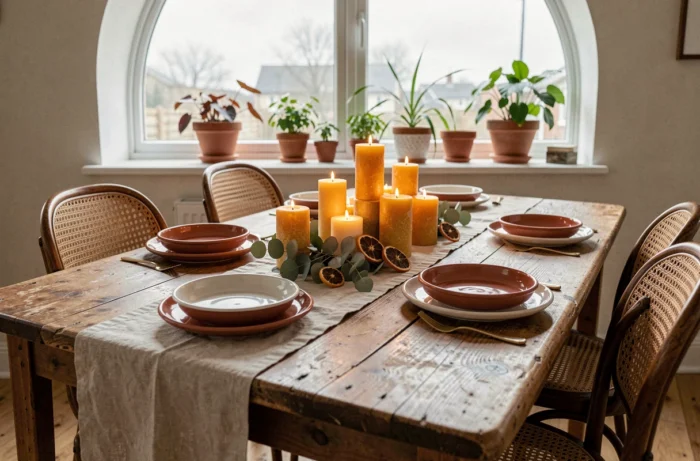
Candles remain an underrated decor tool. Grouped in threes on a wooden or ceramic tray, they create a lively light point that no LED can replicate. Vegetable waxes (soy, rapeseed) offer a cleaner burn and a more consistent scent diffusion than paraffin.
DIY and handmade objects: what really works in personalization
The most effective DIY projects in personalized decoration are not the most complex. A grouped photo frame on a wall (gallery wall) mainly requires precision in alignment and frame selection, not any particular artistic skill.
Three categories of DIY projects produce a visible result:
- Creations in air-drying modeling clay (bowls, candle holders, catchalls) bring a handmade touch with minimal material investment.
- Furniture makeovers with paint (thrifted dresser, bedside table, shelf) transform a recovered piece into a unique object, provided an appropriate primer is applied to the surface.
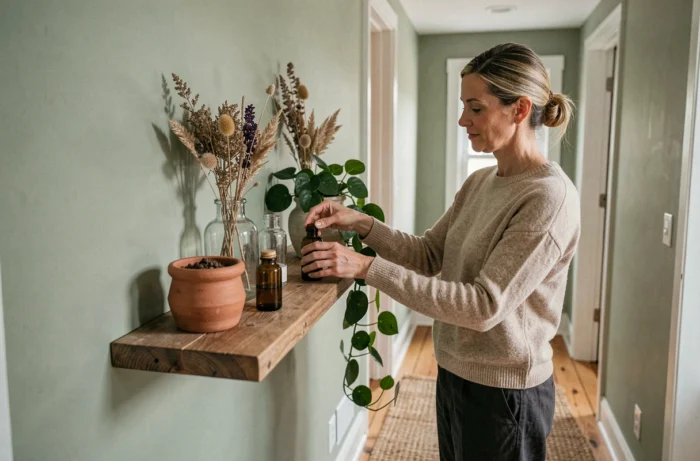
- Compositions of dried flowers, arranged in stoneware or tinted glass vases, offer a durable decoration that evolves with the seasons without maintenance.
Panoramic wallpaper applied to a single wall remains one of the projects with a strong visual impact. Plant or geometric patterns in muted tones (sage, clay, midnight blue) integrate into a warm interior without overwhelming it.
The biophilic approach, which involves integrating living plant elements into every room, is gaining ground. A simple shelf with three green plants of different sizes, placed near a source of natural light, measurably alters the perception of a space. The greenery softens the straight lines of furniture and introduces an organic irregularity that manufactured objects cannot replace.
Ultimately, warm and personalized decoration comes down to one discipline: choosing fewer elements, but selecting them with an understanding of their properties (material, finish, color temperature, proportion). An interior where each object has been considered in relation to its interaction with others looks nothing like any catalog.