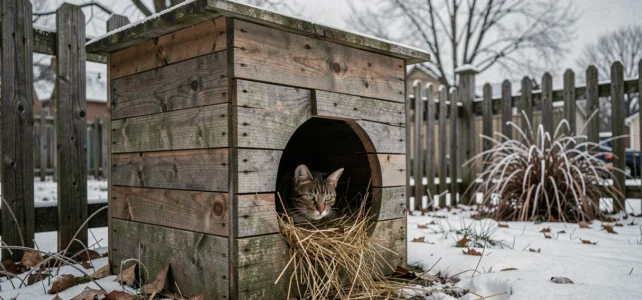
Every winter, thousands of stray cats face the cold with no other protection than what they find under a porch or behind a trash can. The main danger is not the temperature itself, but the combination of humidity and drafts, which quickly lowers the animal’s body temperature. Building an insulated shelter requires neither a significant budget nor special skills, as long as you choose the right materials and avoid some common mistakes.
Reflective insulation and straw: the duo that polystyrene alone cannot replace
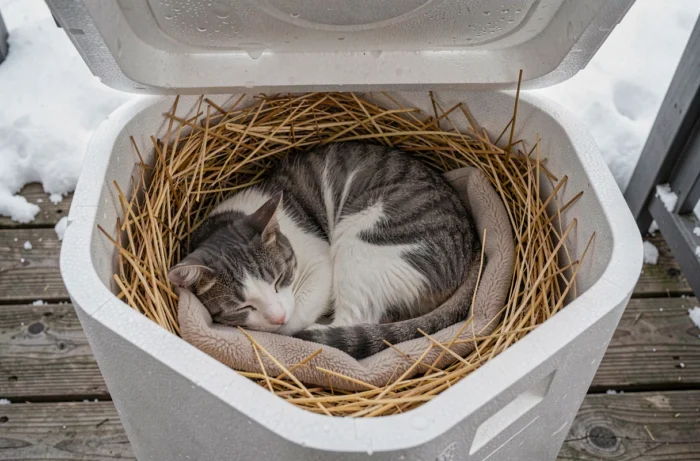
Most guides recommend expanded polystyrene or simple cardboard lined with trash bags. These solutions work, but their durability becomes an issue as soon as humidity sets in. Bare polystyrene absorbs water through capillarity over the weeks, and cardboard disintegrates after a few episodes of rain.
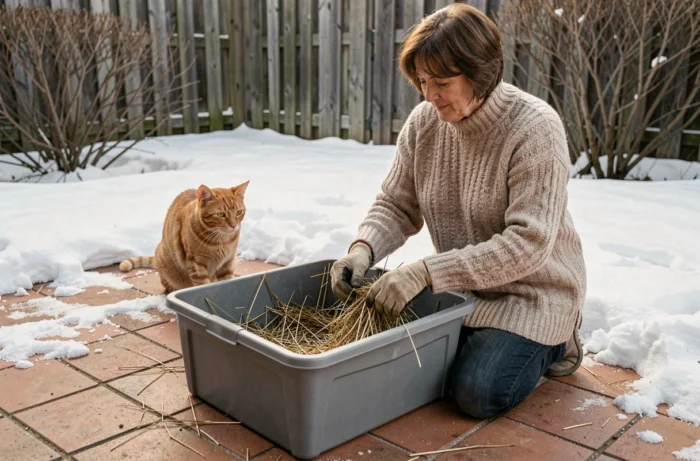
Recommendations published in 2026 highlight a more robust approach: combine bubble reflective insulation with a thick layer of dry straw. The reflective insulation (like Reflectix) is attached to the internal walls and the roof of a rigid plastic bin. The straw lines the bottom and creates a pocket of warm air around the cat.
This setup limits heat loss by radiation thanks to the reflective surface, while reducing condensation on the cold walls. Polystyrene alone does not block this condensation phenomenon, which eventually soaks the bedding and negates the insulating effect.
To ensure the setup lasts over time, it is recommended to use a water-resistant tape (like Gorilla tape) to prevent the cats from dislodging the insulation with their claws. This is a point that classic tutorials based on cardboard boxes never address.
Several resources allow for a deeper exploration of the subject, notably for insulating a shelter for stray cats with Cani Essence, which details the assembly steps suitable for different types of bins.
Double openings and high ventilation: designing a safe shelter against predators
A shelter with a single entrance can become a trap. If a dog or another predator blocks the opening, the cat has no escape route. That’s why animal protection associations increasingly recommend shelters with double openings placed on opposite sides.
The entrance should remain small, sufficient to allow a cat to pass but too narrow for a medium-sized dog. A diameter of about 15 centimeters is suitable for most feline sizes.
Beyond the predator issue, ventilation plays a role that is often underestimated. A completely airtight shelter accumulates moisture released by the cat’s breath. Recent recommendations suggest adding small ventilation openings at the top, just a few centimeters wide, to expel humid air without creating a draft at the ground level where the cat lies down.
Design points to check
- Two diametrically opposite openings, each small enough to exclude predators but sufficient for an adult cat
- One or two high ventilation slots (no more than two centimeters wide) to expel condensation without cooling the interior
- A raised bin a few centimeters off the ground, on blocks or a pallet, to avoid moisture rising and contact with frozen ground
- A slight slope of the roof towards the back to ensure rainwater flows away from the entrances
Straw, fabrics, blankets: what really works as insulating filling
There is a strong temptation to place an old blanket at the bottom of the shelter. The gesture comes from good intentions, but a fabric that absorbs moisture becomes a source of cold rather than protection. A blanket soaked by condensation or by a cat coming in wet takes hours to dry in a closed space, and the perceived temperature drops.
Straw remains the reference filling for outdoor shelters. It traps air between its strands, dries quickly, and does not retain the cat’s body moisture. Hay, on the other hand, should be avoided: it absorbs moisture and can promote mold growth.
A often overlooked point of vigilance: straw must be replaced regularly throughout the winter. After a few weeks, it compresses, loses its insulating power, and can accumulate parasites. Replacing it every two to three weeks maintains the thermal efficiency of the shelter.
Location of the shelter: orientation, ground, and proximity to food
An ideally insulated shelter but poorly placed loses much of its effectiveness. The entrance should be oriented away from prevailing winds, usually towards the south or east in most French regions. Placing the opening facing northwest directly exposes the interior to winter weather.
The ground matters as much as the walls. Placing a shelter directly on the earth or concrete creates a thermal bridge from below. Raising the bin on wooden blocks or a pallet is enough to cut this cold contact.
Food and water nearby, but not inside
Place the water and food bowl a few meters from the shelter, not inside. Food inside attracts other animals (rats, weasels) and dirties the filling. Water, on the other hand, risks freezing quickly outside. Bowls that are slightly deeper than wide and placed in a partially sheltered spot freeze less quickly than a flat bowl exposed to the wind.
- Bowls placed at a distance from the shelter to avoid attracting predators to the entrance
- Water renewed at least once a day during freezing weather
- Wet food removed after a few hours to prevent it from freezing and becoming inedible
Before setting up a permanent feeding point, checking if the cat already frequents another feeding site managed by a local association or a neighbor helps avoid spreading resources and facilitates the animal’s health monitoring.
A well-designed shelter, filled with fresh straw, raised, and properly oriented offers a stray cat real protection against the coldest nights. The gesture requires little means. What makes the difference over time is maintenance: renewing the straw, checking the condition of the insulation, ensuring that the openings are not blocked. A forgotten shelter eventually becomes a damp trap, the exact opposite of what we seek to provide.