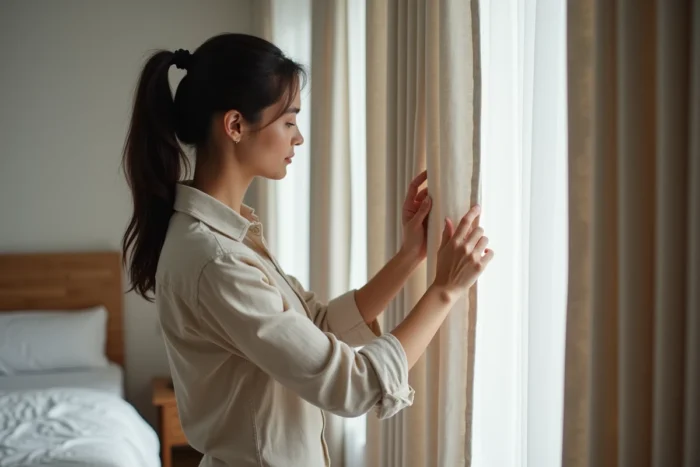
A blackout curtain is defined by its ability to block outside light thanks to a dense fabric or a lining with an opaque coating. Not all curtains sold under this label are equal. Some allow a halo of light to filter through at the edges, while others lose their opacity after a few washes. Evaluating the actual effectiveness of a blackout curtain requires going beyond the commercial label and relying on verifiable criteria.
Glass Temperature: The Test No One Does
Most guides focus on the darkness achieved. However, light blocking is only part of the problem. In summer, a curtain can block visible light while allowing a significant amount of infrared radiation, which heats the room, to pass through.
To verify this, simply use an infrared thermometer pointed at the inner surface of the glass, with the curtain closed. Beyond about 35 °C on the sun-exposed side, the curtain poorly restricts heat gain. This threshold, used by solar film professionals, provides a concrete benchmark for comparing your curtain to other devices.
This test takes thirty seconds and costs the price of a kitchen thermometer. It also allows you to check a blackout curtain on Direct Maison before deciding if a replacement or an addition (heat-reducing film, exterior blind) is justified.
Field data shows that the reduction of solar gain by a blackout curtain remains modest, around 20 to 35%, whereas a solar film can reject 70 to 82% of radiation. Blocking light and blocking heat are two distinct functions, and a blackout curtain excels mainly at the former.
Light Blocking: Fabric Weight and Quality of Construction
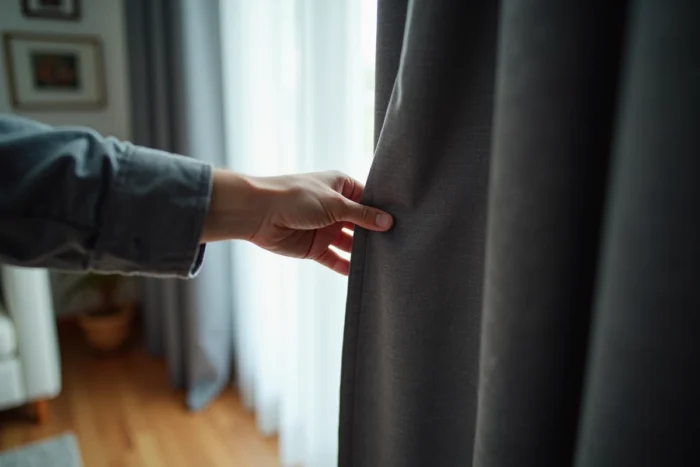
The opacity of a curtain primarily depends on the density of its fabric. A sufficiently dense weight, combined with a coated backing or foam lining, blocks nearly all light. Thin fabrics sold as “blackout” without coating often allow a diffuse halo to pass through, especially in full sunlight.
The Flashlight Test
Place a strong light source (smartphone flashlight mode) directly against the fabric. If the light passes through as points or a diffuse patch, the curtain is semi-blackout, not blackout. A true blackout curtain does not allow any light to pass through the fabric.
This test alone is not sufficient. Light blocking also occurs at the edges.
Side, Top, and Bottom Leaks
A perfectly opaque fabric loses its usefulness if light enters from the sides. Three verification points:
- The width of the curtain exceeds that of the window by at least fifteen centimeters on each side, to cover the wall and eliminate side light bands.
- The curtain hangs low enough not to leave a gap under the hem, especially on ground floor windows exposed to outside lighting.
- The mounting system (rod with side returns, recessed track) presses the fabric against the wall rather than allowing it to float freely.
A curtain that is too narrow or too short remains a decorative curtain, not a functional blocking device.
Blackout Curtain and Thermal Insulation: Two Performances to Distinguish
The term “thermal blackout” encompasses very different products. A curtain with a simple white acrylic backing does not insulate as much as a model lined with multilayer foam.
Blackout concerns light, insulation concerns the transfer of heat and cold. A curtain can achieve a maximum blackout score while offering negligible thermal insulation. The reverse is rarer, as insulating materials are generally opaque.
To assess the thermal component, the infrared thermometer test described above remains the most reliable in real conditions. In winter, the same measurement on the glass (interior side, curtain closed) indicates whether the curtain creates a sufficient air gap to slow down heat loss.
So-called thermal curtains use materials like coated polyester, PVC foam, or triple woven layers. The presence of an air gap between the fabric and the glass is as important as the fabric itself: a curtain pressed against the glass insulates less than a curtain placed a few centimeters away.

Durability of Blackout After Washing and Sun Exposure
A new blackout curtain can lose its properties within a few months. Two factors accelerate this degradation.
Washing in a machine at too high a temperature can peel or crack the opaque coating. After three or four cycles at 40 °C or higher, micro-perforations appear in the coating. The fabric may look intact to the naked eye, but the flashlight test reveals bright spots that did not exist at the time of purchase.
Prolonged exposure to UV light also degrades the backing of the curtain. Models with black or dark coatings heat more and age faster than those with white or silver backs, which reflect some of the radiation.
To maintain effectiveness over time:
- Wash in cold water or at a maximum of 30 °C, without intensive spinning.
- Prefer a light backing that undergoes less thermal stress.
- Repeat the flashlight test after each season to detect the first signs of opacity loss.
A blackout curtain that passes the light test after two years is better than a budget model replaced every year.
The blackout curtain is increasingly appearing in discussions about summer comfort in homes, to the point of being mentioned among the equipment assessed during housing assessments in heatwave periods. Testing yours with a thermometer and a flashlight takes five minutes, and these two simple actions provide a more reliable answer than any product sheet.