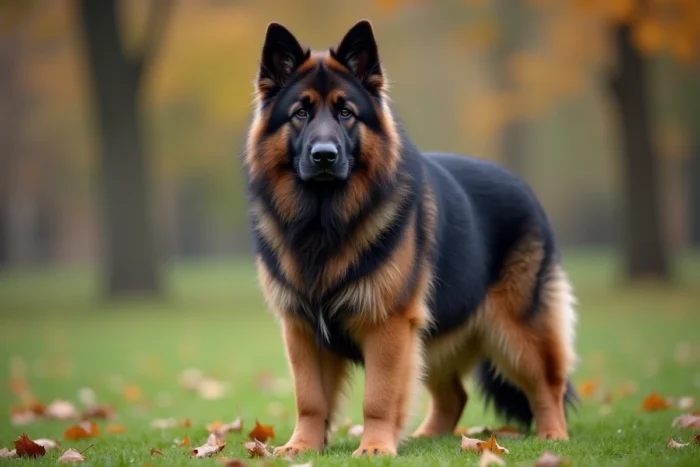
The German Shepherd crossed with Newfoundland does not conform to any official breed standard. Each litter produces puppies with varying proportions, sometimes closer to the shepherd, sometimes to the Newfoundland, and occasionally a mix that is difficult to anticipate. To compare this crossbreed to its two parent breeds, one must lay the data side by side and observe where the actual morphological differences lie.
German Shepherd, Newfoundland, and Crossbreed: Size Comparison
The table below gathers the documented physical trends for each parent breed and the characteristics frequently observed in the crossbreed.
| Criteria | German Shepherd | Newfoundland | Crossbreed GS x Newfoundland |
|---|---|---|---|
| General silhouette | Athletic, sloping back line | Massive, rectangular, broad chest | Heavier build than a GS, more slender than a Newfoundland |
| Head | Elongated, moderate stop | Wide, rounded skull, short muzzle | Head often more elongated than the Newfoundland, wider skull than the GS |
| Coat | Double, medium-length, dense undercoat | Double, long, oily, waterproof | Double, denser than a standard GS, variable texture |
| Legs | Long, angular | Wide, webbed | Partial webbing possible, sturdy legs |
| Tail | Saber-shaped, low set | Wide at the base, low set | Thick, often bushy |
This table shows that the crossbreed never falls exactly in the middle of its two parents. Certain traits dominate depending on the individual, making each dog physically unique within the same litter.
To better understand the characteristics of the German Shepherd crossed with Newfoundland, one must examine in detail the coat and skeletal structure, two areas where the differences between individuals are most pronounced.
Coat of the German Shepherd Newfoundland Cross: Texture and Maintenance
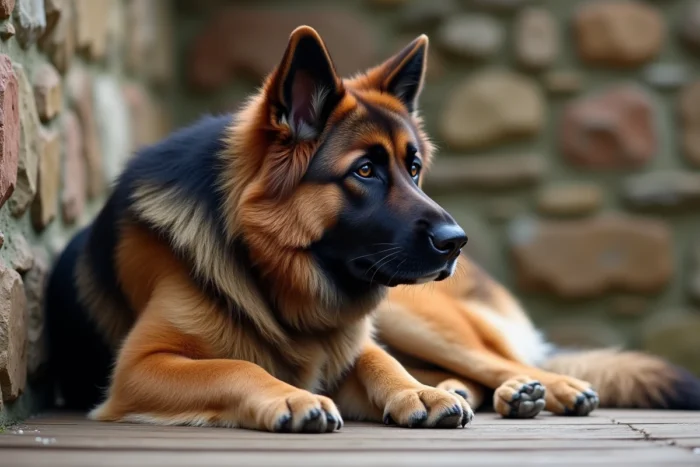
The German Shepherd has a double coat with a dense undercoat, suitable for temperature variations. The Newfoundland also has a double coat, but significantly longer, with an oily texture that makes it waterproof. This property, linked to the Newfoundland’s historical ability to work in cold water, is a strong genetic marker.
In the crossbreed, the double coat is almost systematic. However, the length and texture vary considerably. Some individuals inherit a medium-length dense coat but less oily, resembling the shepherd. Others develop a longer coat, with a greasy texture reminiscent of the Newfoundland, particularly around the chest and thighs.
Shedding and Coat Volume
Both parent breeds are heavy producers of undercoat during shedding periods. The crossbreed often accumulates this tendency. Seasonal shedding produces a significant volume of dead hair, sometimes exceeding that of a standard German Shepherd.
- Brushing should be regular, at least two to three times a week outside of shedding periods, daily during spring and autumn sheds
- Poorly maintained undercoat forms dense mats near the skin, promoting skin irritations and moisture retention
- The oily texture inherited from the Newfoundland, when present, requires suitable shampoo to avoid a sticky effect without destroying the natural protective barrier of the coat
A crossbreed with long, oily fur requires more maintenance than a pure German Shepherd. This factor should be anticipated before adoption.
Skeletal Structure and Musculature: What Newfoundland Blood Changes
The German Shepherd is an agile herding dog, built for running and quick direction changes. Its musculature is lean, and its limbs are long and angular. The Newfoundland, on the other hand, is a draft and water rescue dog. Its build is massive, with a deep chest, thick and powerful musculature.
The crossbreed almost always inherits a wider thorax and heavier build than the German Shepherd. The back line often remains straighter than that of a pure GS, with the Newfoundland partially correcting the characteristic slope of the shepherd. This point is notable because the sloping back line of the German Shepherd is associated with well-documented joint vulnerabilities.
Legs and Webbing
The Newfoundland has webbed feet, a morphological adaptation for aquatic work. This webbing can be passed on to the crossbreed, either partially or completely. A crossbreed with visible webbing will generally have a natural ease in aquatic environments, inherited directly from its Newfoundland parent.
The legs of the crossbreed are often shorter and thicker than those of the German Shepherd, with more compact joints. This structure alters the gait: less stride length, but increased stability on uneven terrain or in wet conditions.
Head and Facial Expression of the German Shepherd Newfoundland Cross
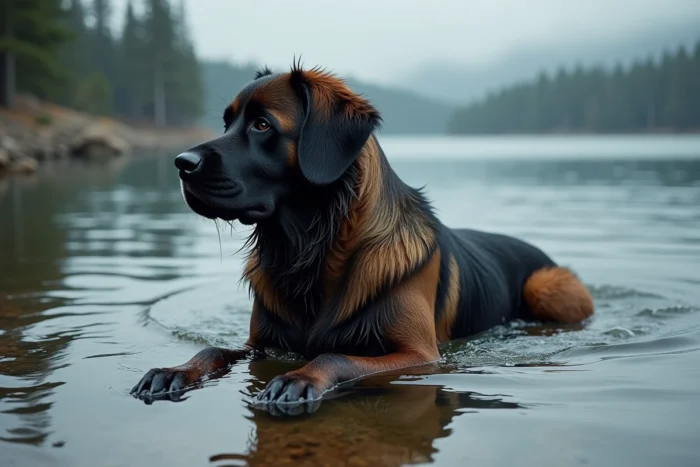
The head is the area where the genetic mix is most easily read. The German Shepherd has an elongated skull, a fine muzzle, and erect ears. The Newfoundland has a wide, rounded skull, a shorter muzzle, drooping ears, and pronounced lips.
In the crossbreed, the head tends to be more elongated than that of the Newfoundland but wider than that of the shepherd. The ears are a reliable indicator of genetic dosage:
- Erect or semi-erect ears: dominance of the German Shepherd phenotype
- Drooping and thick ears: dominance of the Newfoundland phenotype
- Rose-shaped ears (folded over themselves): frequent intermediate mix in the first generation
The shape of the ears is the most immediate visual marker for estimating the genetic proportion of each breed in a given individual. The eyes of the crossbreed are often medium-sized, with a softer expression than that of the shepherd, inheriting the characteristic expression of the Newfoundland.
This crossbreed produces dogs with variable but consistent morphology: a powerful body, a demanding coat, and a head that tells, in itself, the genetic story of each individual. The only certainty when faced with a German Shepherd crossed with Newfoundland is that no specimen looks exactly like another.