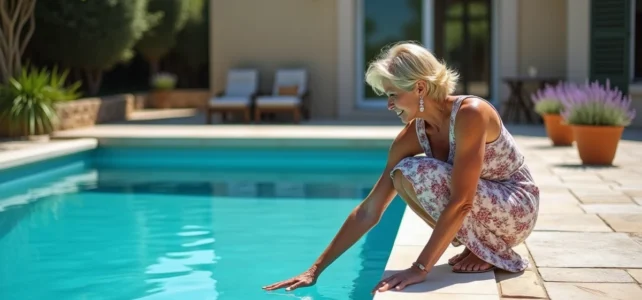
The color of the gel coat of a swimming pool shell determines the hue of the water, the ambiance of the garden, and the ease of maintenance of the pool. This choice accompanies your outdoor space for decades, and it is based on more technical criteria than just a simple crush on a color chart.
Gel coat and water perception: what the shell color really changes
Have you ever noticed that the same pool looks turquoise at one neighbor’s and emerald green at another’s? The difference rarely comes from the water. It comes from the bottom.
The gel coat, this pigmented resin that covers the polyester shell, absorbs or reflects sunlight depending on its hue. It is the gel coat that creates the color of the water, not the water itself. A white bottom produces a bright sky blue. A light gray bottom gives a contemporary blue-green water. A beige or sandy bottom leans towards lagoon turquoise.
Dark shells (anthracite gray, black, very dark blue) create a striking mirror effect. They absorb more solar radiation, often resulting in a water temperature gain of 3 to 6 °C compared to a light shell under similar conditions. In temperate regions, this detail extends the swimming season by several weeks.
To choose the right pool shell color, you need to think in terms of the final rendering in the water, not just by looking at a dry sample placed on a table.
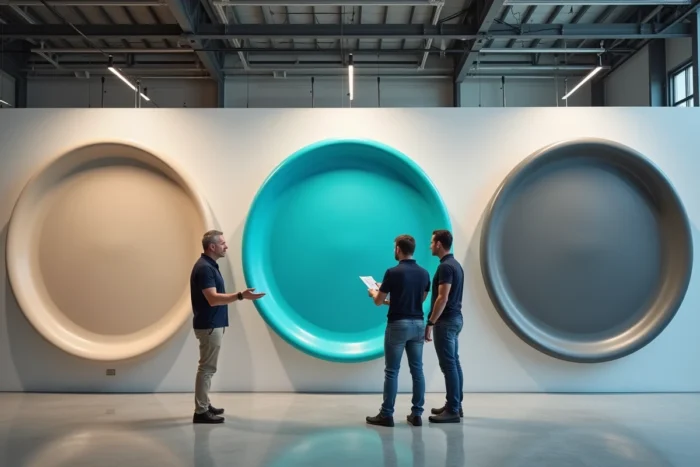
Pool shell color and maintenance: forgiving shades
There is much talk about aesthetics, but rarely about what a color implies in daily life. The choice of hue has a direct impact on the frequency of pool cleaning.
Very light shells: white, ivory
A white bottom reveals every leaf, every trace of lime, every budding algae. The pool appears dirty more quickly, even if the water quality is impeccable. Cleaning must be more regular to maintain a flawless appearance.
Very dark shells: anthracite, black
Lime deposits appear as white streaks on a dark background, creating a very visible contrast. In hard water regions, rigorous anti-lime treatment becomes necessary. Fine dust is also more noticeable than one might think.
Light gray and beige: the maintenance compromise
Pearl gray has become the trendy shade in recent years, and this success is not just aesthetic. Light gray better masks sand, lime, and small impurities than white or very dark gray. Beige offers a similar advantage, with a warmer rendering.
- White or ivory: bright rendering, but frequent cleaning and visible lime traces quickly
- Light gray or pearl: good compromise between modern aesthetics and ease of daily maintenance
- Beige or sand: lagoon ambiance, well masks impurities, suitable for natural environments
- Anthracite gray or black: spectacular mirror effect, but very visible lime deposits and warmer water
Match the pool color with the terrace and coping
Recent choice guides emphasize a holistic approach: the color of the shell should be considered in coherence with the terrace, coping, and vegetation, not in isolation. An anthracite gray pool surrounded by light stone coping creates a sharp and graphic contrast. A beige pool surrounded by exotic wood extends an organic ambiance.
Before finalizing your choice, place the gel coat sample next to the planned decking material. Observe it at different times: the morning light and that at 4 PM radically change the perception of the hue.
Adapt the color to the architectural style
A contemporary house with clean lines naturally pairs with a light gray or anthracite pool. Facades with light plaster and canal tile roofs call for a sandy or beige bottom. Stone or wood-clad homes benefit from staying with natural shades that do not create a visual break with the environment.
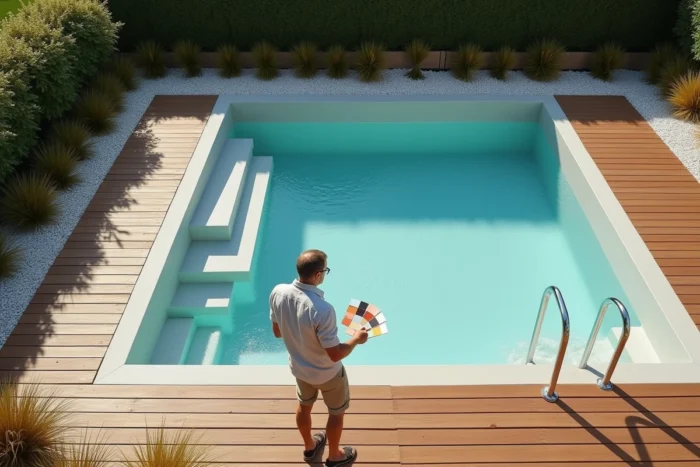
Sun exposure and climate: a criterion that color charts do not display
The sunlight on your property alters the perceived color of the water throughout the day. A south-facing pool, bathed in direct light, always lightens the hue. A light gray bottom will appear almost blue at noon. A beige bottom will turn bright turquoise.
Conversely, a pool in a shaded area (trees, wall, neighboring house) darkens the hue by one to two tones. A dark gray in a shaded area can give water an almost black appearance, which is not always the desired effect.
In temperate climates, dark shells provide a real thermal advantage. In Mediterranean regions, where summer heat is already high, a light shell limits temperature rise and remains more pleasant to the touch of feet.
- Full south and high brightness: favor a medium gray or beige, which will not appear washed out
- Partially shaded area: avoid very dark shades that excessively darken the water
- Cool climate: a dark shell helps gain temperature without extra heating costs
Choosing a pool shell color is a long-term commitment. Unlike a replaceable liner, the gel coat is an integral part of the structure. Request a sample submerged in water remains the most reliable test before validating a hue. It is at that moment, and not in front of a catalog, that the true color of your future pool appears.