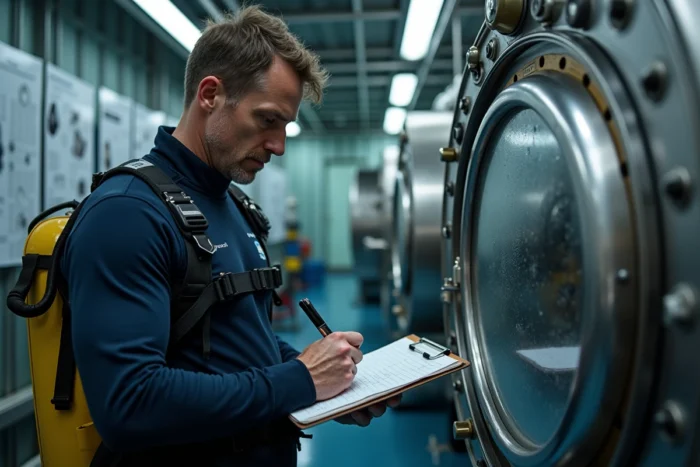
At 3,000 meters deep, the water column exerts a pressure of about 300 bars, which is 300 times the atmospheric pressure at sea level. This hydrostatic gradient turns every technical intervention, every material choice, and every biological protocol into a full-fledged engineering problem.
Mechanical constraints on hulls and materials at 300 bars
The hydrostatic pressure at 300 bars imposes isotropic compression constraints on any submerged structure. A spherical hull made of grade 5 titanium performs better than a cylinder made of stainless steel of the same thickness because the spherical geometry distributes stresses uniformly across the entire surface.
We observe that the primary mode of failure at these depths is not brittle fracture but buckling due to instability. A local micro-deformation, a welding defect, or a thickness variation of a few tenths of a millimeter is enough to trigger a sudden collapse of the structure. The implosion of the Titan submersible in 2023 reminded us that carbon fiber, which performs well in tension, poorly withstands prolonged compression under hydrostatic load.
The portholes represent the sizing weak point of any manned vehicle. The thick methacrylate used for observation domes undergoes slow creep under constant pressure: the material progressively deforms over the diving cycles. A thorough analysis of pressure at 3,000 meters underwater confirms that each component must be individually qualified for its fatigue behavior under repeated cycles, not just for its static strength.
Biological adaptations of abyssal organisms to extreme pressure
Organisms living at 3,000 meters have developed molecular adaptations that surface pressure would render unnecessary. Their cell membranes incorporate a high proportion of unsaturated fatty acids, which maintains membrane fluidity despite compression. Without this adaptation, the membranes would stiffen to the point of blocking cellular exchanges.
The enzymatic proteins of abyssal species exhibit specific amino acid substitutions in their active sites. These modifications allow the enzymes to maintain their functional conformation under 300 bars, where the proteins of a surface fish would unfold and lose all catalytic activity.
A rarely discussed aspect concerns trimethylamine N-oxide (TMAO), an osmolyte that deep-sea fish accumulate in their tissues. This molecule stabilizes proteins against the denaturing effects of pressure. The concentration of TMAO increases in correlation with the species’ depth of life, making it a reliable biochemical marker of bathymetric adaptation.
BBNJ treaty and regulation of activities beyond 3,000 meters
The legal framework applicable to abyssal zones has changed. The High Seas Treaty (BBNJ) came into force on January 17, 2026. This text, an implementing agreement of the United Nations Convention on the Law of the Sea, now mandates environmental impact assessments for any activity likely to affect the marine environment in the high seas.
The treaty introduces a voting mechanism (rather than consensus) to approve protective measures. A single state can no longer block the creation of marine protected areas covering abyssal zones where pressure far exceeds 300 bars.
For deep-sea mining, the implications are direct:
- Any exploration campaign at 3,000 meters or beyond requires a formal environmental assessment before equipment deployment
- Areas identified as ecologically vulnerable (polymetallic nodule fields, hydrothermal vents) may be subject to binding moratoriums
- Operators must demonstrate that pressure and abyssal conditions do not prevent reliable containment of extraction residues
Engineering challenges for deep underwater cables and infrastructure
Submarine telecommunications cables regularly traverse areas where the depth exceeds 3,000 meters. The pressure at these levels compresses polymer sheaths and gradually reduces the diameter of optical fibers. Manufacturers compensate by oversizing the protective layers, but the real problem lies at the transition points between the continental shelf and the abyssal plain, where pressure variations over short distances generate differential stresses.
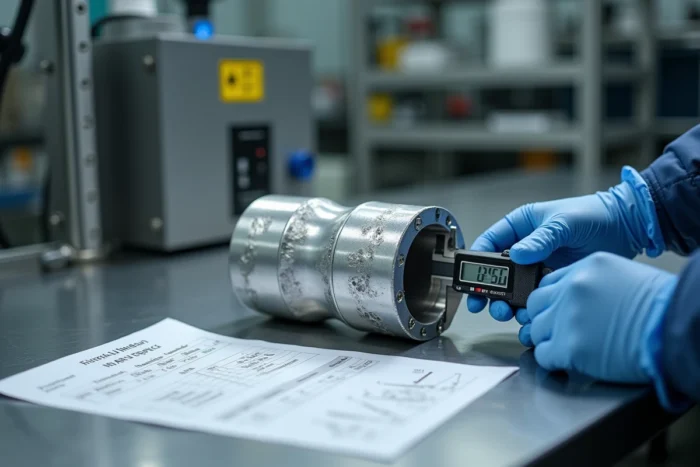
Submarine connectors present a distinct challenge. An electrical or optical connector must maintain its seal at 300 bars while allowing maintenance operations by ROV (remotely operated vehicle). Each connection-disconnection cycle under pressure degrades the elastomeric O-rings, limiting the number of possible interventions before complete module replacement.
Optical repeaters, spaced every few dozen kilometers along transoceanic cables, must operate without maintenance for a target lifespan of about twenty-five years. At 300 bars, even the slightest infiltration of seawater causes accelerated electrochemical corrosion exacerbated by salinity and pressure, making any in situ repair nearly impossible.
Sunken radioactive barrels and risks related to pressure corrosion
France has launched a mission to map the radioactive barrels submerged in the ocean for several decades. These containers, estimated at around 200,000 units, rest at depths where pressure accelerates the degradation mechanisms of metals.
At 300 bars, pitting corrosion develops faster than at the surface. The pressure increases the solubility of dissolved gases in seawater (notably oxygen and carbon dioxide), intensifying electrochemical reactions on the surface of the metal drums. The integrity of these containers after several decades of immersion remains largely unknown.
- Pressure compresses existing micro-cracks but promotes the penetration of water into welding defects
- Corrosion products (iron oxides) form a porous layer that does not effectively protect the underlying metal at these depths
- The absence of strong currents at 3,000 meters limits the dispersion of contaminants but concentrates potential leaks in a restricted perimeter
The combination of extreme pressure, long time, and uncertainty about the condition of the containers makes this issue a case study where the physics of great depths directly intersects with the management of health and environmental risks.