
A tenant visiting two apartments listed at the same rent, one classified as T1 and the other as T1 bis, faces a real comfort gap that a simple label cannot measure. The difference between a T1 and a T1 bis lies in a few square meters and an additional partition, but these details directly impact the monthly budget and how the living space is used on a daily basis.
Shortage of small spaces: a rental market under pressure
Before comparing the two types of housing, one must set the context of the market. Studios, T1s, and T1 bis apartments are gradually disappearing from the rental offer in major French cities. The removal of very energy-intensive housing (DPE F and G) and the slowdown in new construction targeting small spaces have significantly reduced the available stock.
According to several analyses published in the summer of 2026, less than one studio in two remains available for rent in major metropolitan areas. The time to re-rent is measured in days, and landlords are increasingly selective in their applications.
For those looking to understand what a T1 bis apartment is, this tension changes the game: choices are no longer made solely based on comfort, but also based on what is available on the market. Expanding the search from T1 to T1 bis (or vice versa) significantly increases the chances of finding decent housing within a reasonable timeframe.
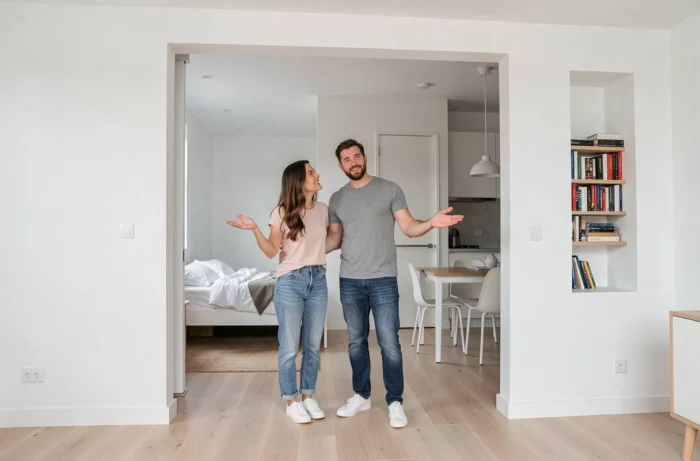
T1 vs T1 bis: how a separate kitchen changes daily life
A T1 includes a main room and a separate kitchen, with an independent bathroom. The T1 bis follows this layout while adding an additional space, often a distinct sleeping area or an alcove large enough to separate the bed from the living room.
On paper, the distinction seems minor. In practice, the alcove or sleeping area of the T1 bis transforms the use of the apartment. One can host someone in the living room without exposing their bed. It separates work from rest. For a student or a young professional working partially from home, this separation is not just a matter of comfort.
Space and layout: the real benchmarks
A T1 typically occupies between 20 and 35 m². The T1 bis is generally above 28 m², but space alone is not enough: a poorly arranged 33 m² T1 may offer less comfort than a well-designed 30 m² T1 bis with an alcove.
What matters during the visit:
- The possibility to visually (curtain, removable partition) or physically close off the sleeping area, which differentiates the T1 bis from a simply spacious T1
- The size of the separate kitchen: some T1s have kitchens so narrow that one can barely stand in them, negating the advantage over a studio with an open kitchenette
- The presence of real storage (built-in closet, pantry) which, in small spaces, greatly enhances daily comfort
Impact on rent: the real gap between T1 and T1 bis
The price per square meter for small spaces is structurally higher than that of T2 or T3 apartments. One pays proportionally more for less space, and this phenomenon intensifies in tight areas.
The rent difference between a T1 and a T1 bis in the same city rarely exceeds the value of a few extra square meters. The monthly additional cost often remains moderate, but it accumulates with slightly higher charges (heating for a slightly larger area, housing tax if applicable).
Overall budget: beyond the monthly rent
People often think too narrowly in terms of gross rent. The real budget for a small apartment includes rental charges, home insurance, energy, and internet access. On these items, the difference between T1 and T1 bis remains marginal: a few euros per month on heating, an almost identical insurance contract.
The real area where the T1 bis saves money is in furnishing. A separate sleeping area allows for a real bed instead of a convertible sofa, which is generally cheaper to purchase and more durable. It also avoids the often costly multifunctional furniture that a studio or compact T1 imposes.
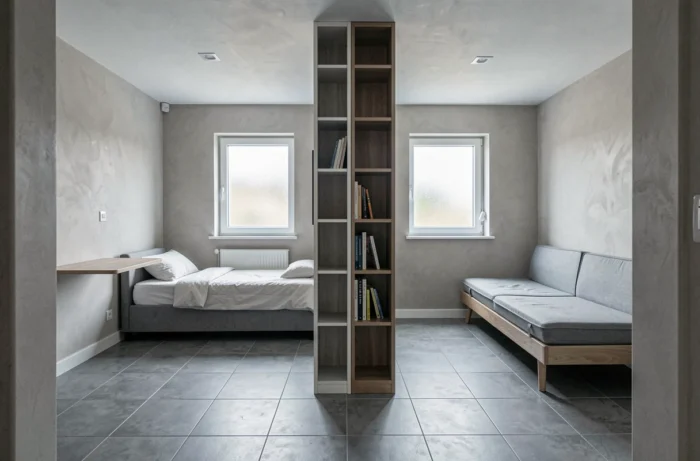
Rental investment: T1 or T1 bis depending on the tenant target
For an investor, small spaces remain the most accessible entry ticket to the real estate market. The choice between T1 and T1 bis depends on the target audience and the city.
A classic T1 rents quickly in university towns with high turnover (students, interns). The turnover is high, vacancy periods concentrate in the summer, and the gross yield remains among the best in the market.
The T1 bis attracts a slightly different profile: young professionals, employees in professional mobility, couples without children. These tenants tend to stay longer, which reduces the costs of refurbishing between leases and limits vacancy risks.
- In pure university areas, the standard T1 increases profitability due to a higher rent per square meter and constant demand
- In mixed city centers (students and professionals), the T1 bis captures a broader demand and stabilizes rental income
- In both cases, a correct DPE (A to D) becomes a non-negotiable criterion to remain in the rental market, given the progressive bans on renting thermal sieves
The trap of price per square meter
Feedback varies on this point, but several investors find that the purchase price per square meter of a T1 bis remains close to that of a T1, while the rent collected progresses less proportionally. The gap in gross yield between T1 and T1 bis often depends on the holding period: the T1 bis sells more easily to an owner-occupier, which secures the investment exit.
The choice between T1 and T1 bis is not just a question of definition or a few square meters. In a market where small spaces are becoming scarce, the flexibility of the T1 bis, its attractiveness to stable tenants, and its resale potential often make it the best compromise, provided the additional cost at purchase or rent remains consistent with the local market.