
The automotive technical review (RTA) is a document that details, model by model, the maintenance and repair procedures of a vehicle: torque specifications, electrical diagrams, disassembly methods, oil change intervals. Obtaining this type of documentation in digital format requires knowing where to look, as formats, publishers, and levels of detail vary by source.
Difference between RTA, workshop manual, and manufacturer sheet
These three terms refer to distinct documents that are often confused. Mixing them up can lead to downloading a file that does not meet the actual need.
The automotive technical review (RTA, historically published by ETAI) is a structured guide for a specific model, written for mechanics and individuals. It covers routine maintenance, timing, braking, electricity, and the engine, with photos or step-by-step diagrams.
The manufacturer’s workshop manual is the internal document of the manufacturer. It is more comprehensive, sometimes spanning several hundred pages, but its technical language is dense and less guided in reading. Some manufacturers make it available on their online portals, while others reserve it for their authorized network.
The technical sheet, on the other hand, is limited to the vehicle’s specifications (dimensions, power, weight). It contains no repair procedures. Downloading a technical sheet thinking it is an RTA is a common mistake.
To find the automotive technical review in PDF suitable for a specific vehicle, the starting point remains the exact identification of the model, engine type, and year of first registration.
PDF formats of technical reviews: what is actually circulating online
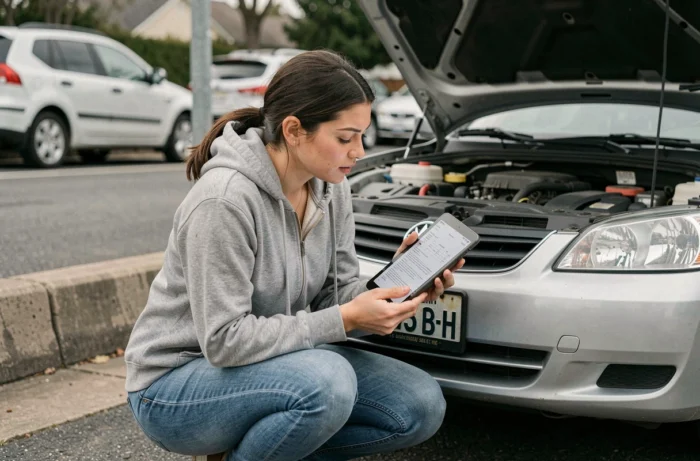
The PDF format remains the most sought after because it can be viewed offline, stored on a phone or tablet, and browsed during an intervention in the garage. In practice, the available files fall into three categories.
- Official publisher PDF: sold by platforms like ETAI (now Infopro Digital) or MecaPlanner. The file is complete, well-formatted, with a clickable index. This is the most reliable version, but it is paid, generally for a price comparable to the paper version.
- Manufacturer documentation PDF: some brand portals (especially for older models or generalist brands) offer excerpts or complete manuals. The level of detail depends on the manufacturer’s policy.
- Unofficial PDFs shared on forums or download sites: their quality ranges from readable scans to truncated files, poorly indexed, or even filled with missing pages. The risk of downloading an incomplete or erroneous document is real.
A truncated PDF may omit the torque specifications for a critical operation, making the procedure unusable or even dangerous. Checking the pagination and the presence of a table of contents before using it helps avoid this trap.
Online technical documentation platforms: an alternative to static PDF
Several online services now offer subscription access to technical databases covering the majority of the automotive fleet. The content is not a downloadable PDF but a searchable web interface, with an internal search engine, filters by system (braking, timing, injection), and regular updates.
This model has a concrete advantage: the data is corrected and supplemented over time, unlike a PDF that is fixed at its publication date. For a recent vehicle whose manufacturer publishes technical notes after release, an online subscription provides access to these supplements.
The trade-off is the dependence on an internet connection. For an intervention in a garage without a stable network, the PDF remains more practical. The two formats are not mutually exclusive: download the PDF for the job, consult the online database to check for a technical update.
Identifying the right document for your model
The primary source of error is an approximate identification of the vehicle. The same commercial name (for example, Peugeot 308 or Renault Clio) covers multiple generations, various engine types, and sometimes several gearbox variants. Procedures differ from one version to another.
The engine code (inscribed on the manufacturer’s plate or on the engine block itself) and the vehicle identification number (VIN) allow for unambiguous identification of the exact version. On reputable platforms, searching by VIN automatically filters the applicable documentation.
Digital battery passport and access to repair data for electric vehicles
For electric vehicles, the landscape of technical documentation is changing. The EU Regulation 2023/1542 on batteries mandates the establishment of a Digital Battery Passport for traction batteries over 2 kWh, starting February 18, 2027.
This passport will be accessible via a QR code affixed to the battery. It will contain information on repairability, disassembly procedures, and maintenance history. Several levels of access are planned: a public section and a section reserved for professionals.
The regulation recognizes the right of independent repairers to access this technical data. For electric vehicle owners, this means that some of the information that would appear in a traditional RTA will be available in the form of a structured electronic file, rather than just in a static PDF.
This system does not replace the technical review for conventional mechanical operations (brakes, suspensions, bodywork), but it complements the documentation on the most specific component of electric vehicles.
Checks before using an RTA in PDF
A technical document is only valuable if it is complete and applicable to the vehicle in question. Before starting an intervention based on a downloaded file, several points deserve systematic verification.
- Exact correspondence between the document and the vehicle: check the generation, engine code, and type of gearbox mentioned on the cover or in the introduction of the file.
- Presence of a table of contents and continuous pagination: a PDF with pages jumping from 45 to 78 has likely been truncated. Missing chapters may concern critical operations.
- Publication date: for recent models, an RTA published in the early months of marketing may not include subsequent technical corrections from the manufacturer.
- Readability of diagrams: low-resolution scans render electrical diagrams unusable. Zooming in on a wiring diagram before validating the document helps ensure this.
The automotive technical review in PDF remains the most direct format for documenting a mechanical intervention. Choosing the right source and verifying the completeness of the file before disassembling anything saves as much time as the procedure itself.