
Massage between partners is often reduced to a preliminary act, a step before sexual intercourse. This reading overlooks what is truly happening under the hands: a bodily dialogue where each pressure, each pause, each slowdown conveys information about desire, boundaries, and consent. Measuring the effects of massage on sexuality requires distinguishing its direct benefits (muscle relaxation, stress reduction) from its relational benefits (listening, non-verbal communication, emotional reconnection).
Massage and bodily dialogue: an often-overlooked tool for consent
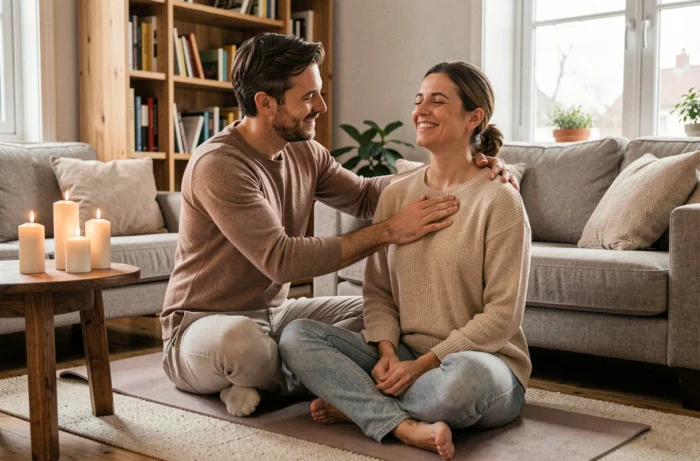
Most content on sensual massage focuses on areas to touch and techniques to replicate. They overlook the communicative dimension of the gesture. Massaging someone is asking a question with your hands and waiting for a response with the body.
In this logic, massage becomes a real-time learning of consent. The person being massaged expresses through their breathing, micro-movements, or muscle tension whether the touch is suitable, if it should slow down, apply more pressure, or change areas. This constant feedback leads to a skill that is directly transferable to sexual intercourse: the ability to read the other person’s body without waiting for explicit verbalization.
Several practitioners of tantric massage emphasize a precise protocol: ask before touching a new area, observe the reaction, adjust. This framework, far from breaking the momentum, establishes a trust that liberates desire. An article detailing the benefits of massage for intimate life confirms that the quality of the connection takes precedence over the gesture technique itself.
This approach changes the nature of massage: it no longer serves to excite, but to create a space where pleasure can emerge without performance pressure.
Indirect effects of massage on sexuality: what relational studies show
Massage does not treat erectile dysfunction or decreased libido. Presenting it as a remedy for these issues would be misleading. Its most solid benefits come through indirect mechanisms.
| Mechanism | Effect on the body | Impact on intimate life |
|---|---|---|
| Stress reduction | Decreased muscle tension, slowed heart rate | Increased mental availability for desire |
| Body awareness | Better perception of skin sensations | Ability to identify and communicate what feels good |
| Emotional reconnection | Release of oxytocin through prolonged touch | Strengthening of attachment bond in the couple |
| Suppression of performance pressure | Absence of orgasmic goal | Resumption of physical contact without anxiety |
Stress is the main barrier to sexual desire, well before hormonal causes in most couple situations. By reducing accumulated stress, massage restores a availability that daily fatigue erodes.
Body awareness deserves particular attention. Many people go through their days disconnected from their physical sensations. Massage forces a return to the body, to feel the skin, the warmth, the pressure. This skill, which some therapists call “somatic presence,” directly improves the quality of sexual relations.
Tantric massage and sensual massage: concrete differences for couples
The terms “tantric massage,” “sensual massage,” and “erotic massage” are used interchangeably online. They cover distinct practices with diverging goals.
- The sensual massage aims for relaxation and awakening the senses through slow strokes, often with warm oil. It may precede sexual intercourse, but that is not its stated purpose. It can be practiced at home without special training.
- The tantric massage is part of a body awareness approach inherited from Indian traditions. It includes synchronized breathing techniques and can last over an hour. The goal is the circulation of energy in the body, not orgasm.
- The erotic massage has a direct intention of sexual stimulation. It targets specific erogenous zones and is integrated into foreplay.
For a couple looking to improve their intimate life, the choice between these three approaches depends on the initial issue. A couple experiencing a lack of desire after several years will benefit more from exploring tantric massage, which re-learns touch without stakes. A couple whose emotional connection remains strong but has fallen into routine will find in sensual massage a simple way to vary sensations.
Unsubstantiated promises to avoid
Some websites claim the existence of “sexual pressure points” capable of triggering orgasm or stimulating hormonal production. These claims remain poorly supported by reliable clinical data. Erotic reflexology has not been the subject of rigorous publications validating these mechanisms.
Similarly, massage does not “boost” testosterone nor correct a hormonal imbalance. Any persistent decrease in libido warrants a medical consultation before considering complementary approaches.
Preparing for a couple’s massage: context matters as much as the gesture
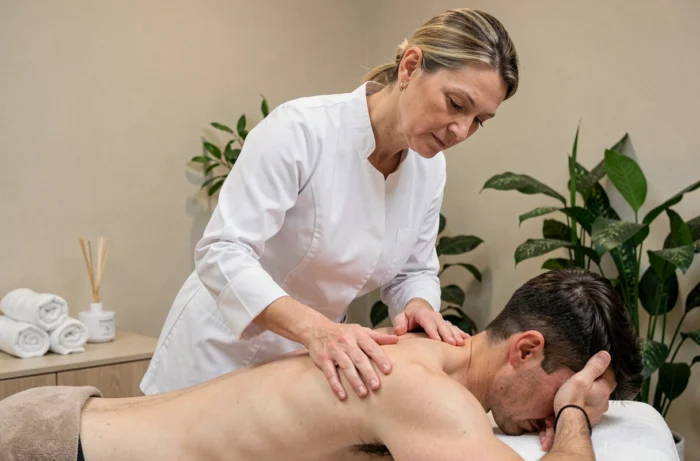
Preparing the environment directly influences the quality of the experience. A massage performed in a cold room, on an unmade bed, with overhead lighting, will not produce the same effects as a setting designed for relaxation.
- Room temperature slightly above usual comfort, to compensate for partial or total nudity.
- Warm vegetable oil warmed between the hands before application (sweet almond, jojoba, or sesame are suitable). Avoid mineral oils that clog pores.
- Dimming lights or candles, silence or very soft music. Silence allows for better perception of the partner’s breathing.
- Predefined duration (twenty to thirty minutes per person). Setting a time frame removes uncertainty and frees attention.
A often overlooked point: reciprocity. Massaging in turns, rather than reserving the active role for one person, transforms the couple’s dynamic. The one who massages develops their tactile listening, while the one receiving practices surrender. Both skills nourish sexuality.
Massage between partners works better as a regular practice than as a one-time event. Integrated into daily life, even in short form (ten minutes on the shoulders or feet), it maintains a channel of physical communication that does not depend on immediate sexual desire. It is this regularity that, over time, changes the quality of the intimate relationship.