
The Yamaha PW80, known as the Piwi 80, remains one of the most popular mini-motorcycles for introducing children to off-road riding. With a displacement of 79 cm³ and its automatic clutch, it is an accessible machine, but its legal framework raises specific questions that many parents do not have clear answers to. Actual speed, legal thresholds, reporting obligations: the topic goes far beyond just the technical specifications.
Adjustable speed limiter on the Piwi 80: a parental device often underutilized
The Piwi 80 features a speed limiter adjustable by an adult, accessible without tools. This mechanism allows the speed to be restricted well below the motorcycle’s maximum mechanical capacity. The idea is to gradually adapt the pace to the child’s age and skill level, making it both an educational tool and a safety device.
This limiter is not just a simple gadget. It directly affects the regulatory status of the vehicle in certain situations. The law prohibits the use of mini-motorcycles by minors under 14 years old if the vehicle can exceed 25 km/h. Setting the limiter below this threshold does not turn the Piwi 80 into a road-legal vehicle, but it determines the legal usage conditions for younger riders.
The question of the maximum allowed speed for the Piwi 80 therefore depends as much on the mechanical configuration chosen by the parent as on the context in which the vehicle is used. A limiter set to maximum does not change the lack of road homologation.
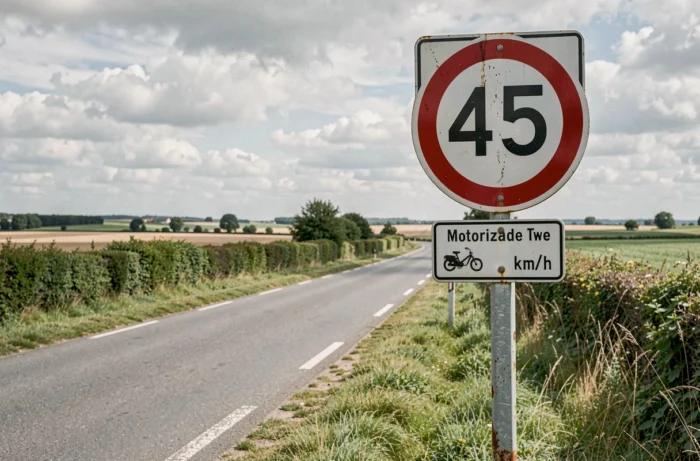
Threshold of 25 km/h and minimum age: what mini-motorcycle regulations say
Mini-motorcycles, including the Piwi 80, are not subject to the reception regime under the Road Code. They cannot receive a registration certificate or circulate on public roads. Their use is limited to private land and approved circuits.
The regulations also impose an age restriction directly linked to speed. A minor under 14 years old cannot use a mini-motorcycle capable of exceeding 25 km/h. This prohibition applies to both purchase and rental. The only exception concerns supervised practice within an approved sports association (FFM, UFOLEP).
In practical terms, for a 6 or 8-year-old on a Piwi 80, the adult must ensure that the limiter keeps the speed below this threshold, except within a club affiliation. Field reports vary on this point: some parents believe that private land is sufficient to bypass this age limit, which is not the case.
Sanctions in case of violation
Using a mini-motorcycle on public roads exposes one to vehicle confiscation and a fine. The lack of registration makes any control immediately problematic. The vehicle having neither lights, mirrors, nor compliant signaling equipment, the list of cumulative infractions is long.
Increased parental responsibility since the law of June 23, 2025
The law n° 2025-568 of June 23, 2025 amended Article 1242 of the Civil Code. Parents exercising parental authority are now “by right, jointly responsible for the damage caused by their minor children.” This responsibility does not require fault on the child’s part: it is sufficient that the damage was caused by their actions, even if not negligent.
A ruling from the judicial court of Mont-de-Marsan on June 9, 2026 (n° 25/00664) reiterated these principles regarding damages caused by a minor. The reasoning is directly transferable to an accident involving a Piwi 80 on private land.
In practice, this means that a parent who allows their child to ride a Piwi 80 at a family gathering or at a neighbor’s house exposes themselves to automatic liability in case of bodily harm</strong caused to a third party. The standard household liability insurance does not always cover recreational motorized vehicles, creating a real financial blind spot.
Liability insurance and non-homologated vehicles
Even on private land, taking out specific insurance for the vehicle is legally required as soon as it has a motor. Several points deserve verification before any use:
- The household insurance generally does not cover accidents related to a motorized land vehicle, even if not homologated for the road.
- A dedicated “motorized recreational vehicle” or “mini-motorcycle” policy must be taken out, including at least liability coverage.
- In the case of practice in an approved club, check if the federal license includes accident coverage or if additional insurance is necessary.
Private land, approved circuit, or club: three distinct legal frameworks for the Piwi 80
The use of a Piwi 80 is not limited to the opposition “road prohibited / private land allowed.” Three contexts coexist, each with its own constraints.
On private land, use is permitted provided that the age limit related to the 25 km/h threshold for those under 14 years old is respected, that appropriate insurance is in place, and that no noise disturbances are generated for the neighbors. The DICEM declaration (Declaration of Identification of Certain Motorized Vehicles) is a legal obligation often overlooked for this type of vehicle.
On an approved circuit, the operator’s rules are added to national regulations. Protective equipment (helmet, gloves, boots) is systematically required. Supervision by an adult remains mandatory for minors.
In a club affiliated with FFM or UFOLEP, the age exception applies: a child under 14 years old can ride a vehicle exceeding 25 km/h under federal supervision. The license often includes accident coverage, but the guarantees vary depending on the federations.
Technical specifications of the Piwi 80 and speed: verifiable data
The PW80 is equipped with a two-stroke engine of 79 cm³ with an automatic clutch. Yamaha designed this machine for learning, not for performance. The power and torque remain modest, suitable for a young audience on soft terrain.
The parental limiter allows for speed reduction well below the mechanical potential. The available data do not allow for setting an exact maximum speed in unrestricted configuration, as it varies according to the rider’s weight, the terrain, and the condition of the motorcycle. Advertisements and forums present disparate figures that would be unwise to take as reference.
What matters from a legal standpoint is the theoretical ability of the vehicle to exceed or not exceed 25 km/h, as this threshold determines age restrictions. The unrestricted Piwi 80 exceeds this threshold, placing it in the category of vehicles prohibited for those under 14 years old outside the federal framework.
The regulatory framework of the Piwi 80 combines texts on mini-motorcycles, parental responsibility, and insurance for motorized land vehicles. None of these aspects can be ignored, even on simple private land. The motorcycle itself, with its integrated limiter, offers a concrete lever to comply with the legal threshold, provided that the adult understands its legal implications and not just its mechanical ones.