
Your phone suggests a response before you’ve even finished reading the message. Your smart speaker starts the morning playlist without a voice command. These micro-automations, now commonplace, rely on rapidly changing technological layers, including regulatory aspects. Understanding what is happening behind these tech trends allows for more informed daily choices.
AI Act and transparency: what is changing in your apps
Since August 2, 2026, a new aspect of the European regulation on artificial intelligence (AI Act) imposes a specific obligation: every chatbot or voice assistant must identify itself as an AI system from the very first interaction. In practice, when you contact your bank’s customer service or an e-commerce site via a conversational agent, a clear message informs you that you are interacting with a machine.
The obligation goes further. Every piece of content generated or modified by AI (text, image, audio, video) must carry a machine-readable marking, such as a digital watermark or a standardized icon. For the user, this translates into small visual mentions in chat threads or under images.
Have you already noticed “generated by AI” labels on certain platforms? Until now, it was only a voluntary approach. Now, it is a legal requirement across the European Union, accompanied by sanctions. The resources published on the tech section of Trop Facile regularly detail these regulatory developments applied to everyday digital tools.
This framework tangibly alters the user experience. An assistant that presents itself as such creates a friction, even slight, that prompts verification of the information received. It is a change in posture: technology no longer hides behind a human appearance.
Prohibited AI uses in daily life: the limits set by law
The European regulation does not stop at transparency. It outright bans certain artificial intelligence practices in everyday life. These prohibitions affect familiar areas.
- Social scoring, which would involve rating citizens based on their online or offline behavior, is prohibited. No administration or company in Europe can deploy this type of system.
- Emotion recognition systems are banned in schools and workplaces. A camera analyzing students’ facial expressions to assess their attention, for example, is now illegal.
- The generation of intimate deepfakes without consent falls under the regulation. Producing or distributing a manipulated intimate image of a real person exposes one to legal action.
These prohibitions protect everyday situations, not just dystopian scenarios. They concern your children’s school, your office, your online interactions. This is a dimension that “tech trend” lists generally overlook, even though it directly conditions what software publishers can or cannot offer.
Connected devices and voice assistants: beyond the gadget
Connected devices are no longer limited to fitness bands or smartphone-controlled light bulbs. The new generation incorporates more varied sensors and processes some data locally, without going through a remote server. This principle, known as edge computing, means that processing occurs directly in the device, at your home.
Why this technical choice? Two main reasons. The first is speed: a surveillance camera that detects suspicious movement reacts faster if it analyzes the image on-site. The second is privacy: fewer data transmitted to the cloud means less risk of leakage.
Voice assistants and new transparency constraints
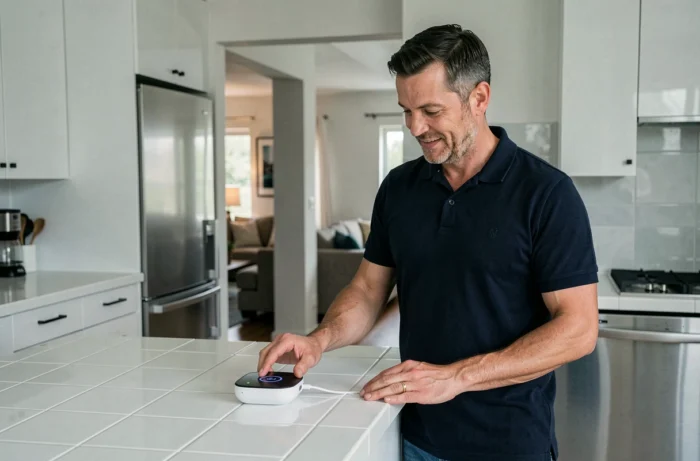
Home voice assistants are directly affected by the AI Act. Every AI-generated response must signal this. In practice, this means that your smart speaker could add a brief audio or visual mention (on the associated screen) before delivering information.
For the user, the impact is twofold. On one hand, trust in the provided responses may increase due to this transparency. On the other hand, the experience becomes a bit less fluid. Manufacturers are working to make these mentions as discreet as possible without violating regulations.

Digital transformation of businesses: what SMEs are really adopting
Major technological trends do not only affect individuals. Businesses, including small structures, are gradually integrating digital tools that change their daily operations.
The development of business applications without coding (so-called “no-code” or “low-code” approach) allows marketing or sales teams to create their own forms, dashboards, or automations. A marketing manager can connect their customer data to an email sending tool without needing to consult a developer.
Customer data and business software
Customer data management remains an evolving field. Customer relationship management (CRM) software now includes predictive analytics modules. They suggest, for example, the best time to follow up with a prospect or identify customers at risk of unsubscribing.
This automation raises the question of measurement: how to assess whether these tools provide real benefits? The companies that get the most out of their digital transformation are those that define clear indicators before deploying a new tool, not after.
The European regulatory framework also influences these choices. Software solutions hosted on sovereign servers (based in the EU) are gaining ground against American offerings, particularly in sectors handling sensitive information.
The current tech trends are not just a list of gadgets. They come with new legal constraints, technical architecture choices (local or remote processing), and strategic decisions for businesses of all sizes. Understanding these mechanisms helps distinguish a truly useful tool from a passing fad.