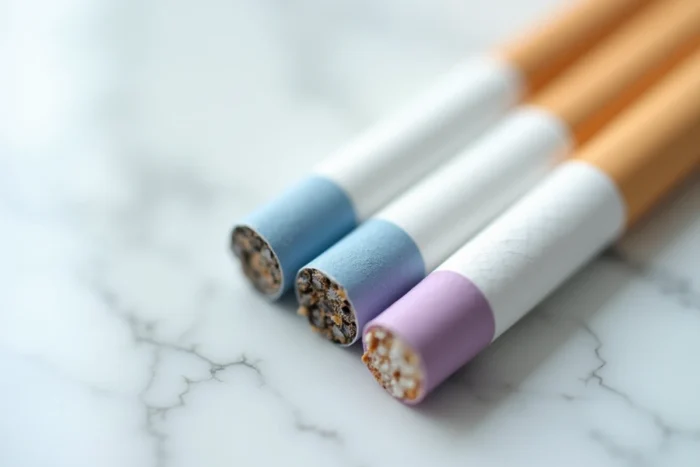
When buying a pack of Vogue, the color of the packaging influences the choice as much as the price. Blue, Lilac, Character: each variant corresponds to a specific technical setting of the filter and the tobacco blend, not just an aesthetic preference. Understanding what lies behind these color codes allows us to measure what we really inhale, far from the marketing promises of lightness.
Ventilated filters and machine measurements: the mechanism that color doesn’t show
On a Blue Vogue, the filter has micro-perforations that allow ambient air to enter during inhalation. This system dilutes the smoke analyzed by testing machines, which lowers the tar and nicotine figures displayed on the product sheet.
The problem is simple: in real conditions, we pinch the filter between our lips or fingers. The perforations become partially blocked, and the dilution intended by the manufacturer no longer works. The inhaled smoke then contains much more tar than the official measurement indicates.
This discrepancy between machine measurement and actual exposure applies to the entire Vogue range, but it amplifies on the references presented as milder. A Lilac Vogue, advertised with low levels of tar and nicotine, relies more on the ventilation of the filter to achieve these figures.
By drawing normally on it, we reduce the gap with a Blue more than we think. We are talking here about the color difference of Vogue cigarettes, which is primarily a filter setting, not fundamentally different tobacco.
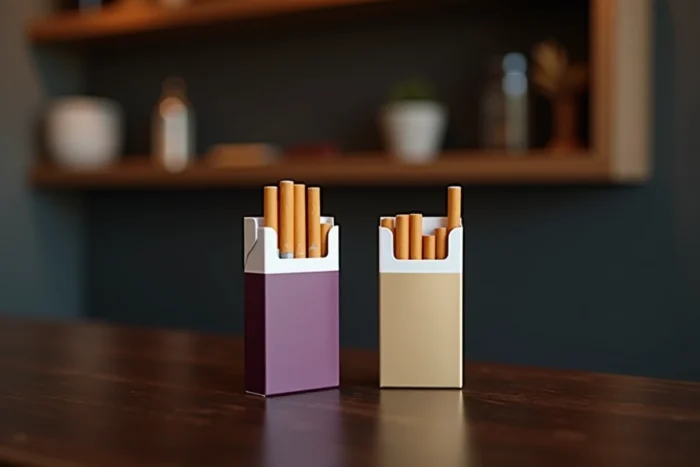
Tar and nicotine by Vogue reference: the technical levels behind each color
The product sheets from distributors detail measurable levels for each sub-reference. According to available data, the Blue Vogue is around 0.7 mg of nicotine and 8 mg of tar, with a carbon monoxide level of 8 mg. The Lilac Vogue drops to about 0.4 mg of nicotine and 4 mg of tar, with 3 mg of carbon monoxide.
These figures, obtained under standardized laboratory conditions, outline a clear hierarchy between the variants. The Character range (Blue and Lilac) positions itself on intermediate values or close to the standard version, depending on the sub-reference.
What these levels mean in practice
A difference of a few milligrams of tar does not change the health risk profile. When we block the ventilation holes of the filter to replicate real usage conditions, the measured levels of tar, nicotine, and carbon monoxide are significantly higher than the displayed values.
In other words, switching from a Blue Vogue to a Lilac Vogue to reduce exposure relies on figures that underestimate reality in both cases. The compensatory gesture also plays a role: with a cigarette perceived as lighter, we draw harder and deeper, which increases the inhalation of carbon monoxide and toxic particles up to the lung alveoli.
“Additive-free” mention on Vogue: a commercial argument to put into perspective
The manufacturer claims the absence of additives in the tobacco and filter of its Vogue cigarettes. This mention, highlighted on the packs, feeds an image of product purity.
The absence of additives does not reduce the toxicity of tobacco combustion. The smoke from an “additive-free” cigarette contains the same families of carcinogenic substances (tar, benzene, formaldehyde) as that of a cigarette with additives. The danger comes from the combustion itself, not just from what is added to the blend.
Why this marketing strategy works
The “additive-free” positioning targets an audience concerned about product composition, creating an implicit parallel with organic or natural food. It’s a powerful lever, but misleading from a health perspective. Smoking pure tobacco is just as harmful as smoking tobacco with additives.
Revision of the European tobacco directive: towards the end of ventilated filters
France is currently pushing the European Union, as part of the revision of the Tobacco Products Directive (TPD), towards a complete ban on filters. This position does not only target flavors or packaging: it directly targets the ventilation mechanism of the filter that allows manufacturers to display artificially low tar levels.
If this ban goes through, the Vogue range would lose its main technical differentiation tool between variants. Without a ventilated filter, the differences in tar and nicotine between a Blue and a Lilac would be significantly reduced, making color segmentation even less meaningful than it already is.
Here are the key points to consider when evaluating what a color code on a Vogue pack really means:
- The displayed tar and nicotine figures are measured by machine, under conditions that do not replicate how we actually smoke
- The ventilated filter is the main technical lever that separates a “mild” variant from a “standard” variant, not the tobacco composition
- The compensatory gesture (drawing harder on a cigarette perceived as light) largely cancels out the theoretical gap between the references
- The “additive-free” mention has no demonstrated impact on reducing combustion-related risks
Feedback varies on the perception of smoothness between variants, but technical data converge: the color of the pack mainly alters the perceived experience, not the actual toxicological exposure. As long as combustion remains the mode of consumption, no color code transforms a cigarette into a reduced-risk product.