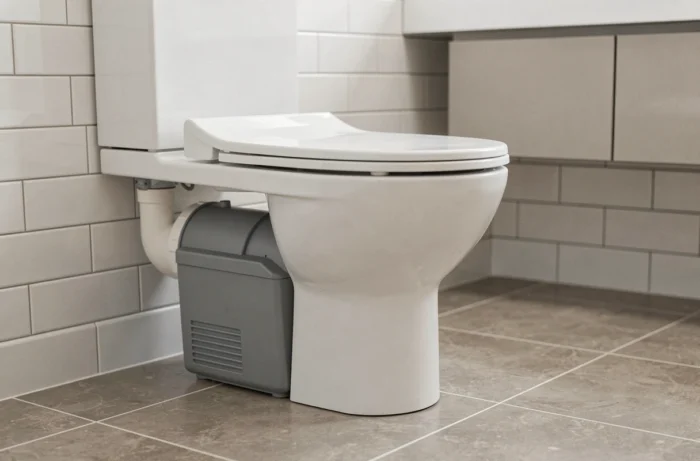
Installing a toilet in a room far from the main drainage stack is often the starting point. The macerating toilet solves this problem by grinding waste and pushing it through a small diameter pipe. However, not all models are suitable for every bathroom, and some criteria go far beyond just power or design.
Regulatory and Electrical Compliance of the Macerating Toilet
Before comparing models, check if your property allows this installation. In France, the macerating toilet remains a solution considered exceptional: it is justified when a traditional toilet with gravity drainage is technically impossible.
In a co-ownership, the issue becomes more complicated. If the connection affects common pipes, the agreement of the general assembly may be required. Ignoring this step exposes you to a formal notice, or even the obligation to remove the installation.
The electrical supply is another often-overlooked selection filter. A macerator must be connected to a socket protected by a 30 mA differential device, grounded, and positioned away from areas exposed to water splashes. In a small bathroom, this constraint can render a model perfectly compatible hydraulically simply unusable. Have your electrical panel checked before ordering.
To choose a suitable macerating toilet for your configuration, you must therefore cross-reference these regulatory and electrical constraints with the technical characteristics of the product, not the other way around.
Discharge Height and Drain Pipe Diameter: The Two Important Numbers
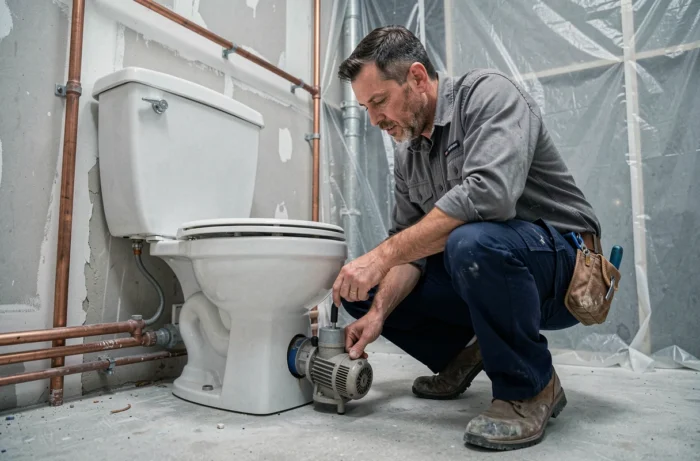
Are you installing the macerator in the basement, in an attic, or simply far from the main network? The horizontal distance and vertical height between the bowl and the connection point determine the type of motor needed.
Discharge Height
This is the macerator’s ability to push water upwards. A model intended for a basement will need to lift water several meters, whereas a macerator installed on the same floor as the drainage will have almost no elevation to compensate for. The higher the discharge height, the more the motor is stressed.
A common trap: only considering the vertical height without taking into account the horizontal length of the pipe. A bend, a winding path, or a pipe that is too long reduces the effective discharge capacity.
Drain Pipe Diameter
A traditional toilet requires a 100 mm pipe. The macerator allows for much smaller diameters, making it possible to pass through narrow walls or technical ducts. Check the minimum diameter accepted by the chosen model and ensure it matches your existing network.
Noise and Vibrations: A Criterion That the Technical Sheet Does Not Suffice to Evaluate
Most guides compare the decibels advertised by manufacturers. This figure is measured in a laboratory under ideal conditions. In your bathroom, the result will be different.
The vibrations transmitted through the floor and walls amplify the perceived noise. A macerator placed directly on a tiled floor without vibration decoupling will be noisier than an identical model installed on a soft support. Some manufacturers offer anti-vibration pads, but installation on a rigid floor without treatment remains the norm in quick setups.
Why is this point often underestimated? Because the motor noise lasts only a few seconds per cycle. During the day, this is tolerable. At night, in an apartment with lightweight walls, the grinding cycle wakes up occupants in the adjacent room. If the bathroom is next to a bedroom, opt for a model with an isolated motor and plan for decoupling during installation.
Number of Inlets and Connection of Other Sanitary Appliances
A macerating toilet does not always serve only the toilet. Depending on the model, you can connect other bathroom equipment:
- A sink or a washbasin, which simplifies drainage in a room without a dedicated network
- A shower, provided the flow rate is compatible with the macerator’s pumping capacity
- A bidet, for configurations where gravity drainage does not exist
Each additional inlet puts more demand on the motor. A macerator designed for the bowl alone will not support the continuous flow of a shower. Check the number of available inlets and the maximum flow rate allowed before planning your connections.
Integrated Macerator or Adaptable Macerator: Which Type for Your Bathroom
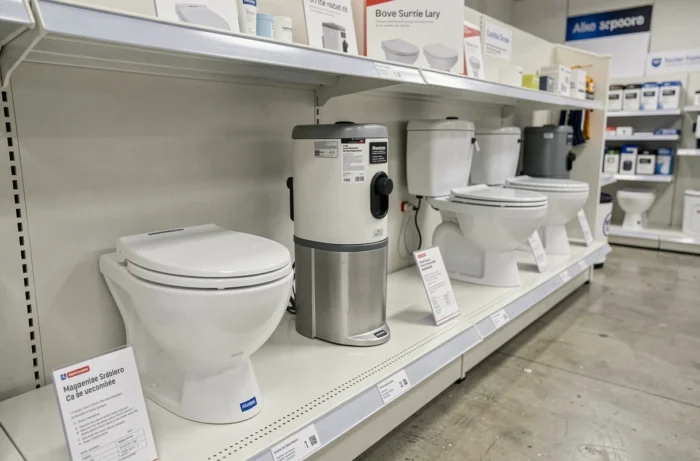
There are two main families, and the choice depends on your starting situation.
- The macerating toilet with an integrated macerator forms a complete unit (bowl, tank, and macerator). Installation is simpler, and the whole is often more compact, which is suitable for small bathrooms
- The adaptable macerator attaches behind an existing toilet. It allows you to keep a traditional bowl and only replace the drainage system
- The macerator for wall-mounted toilets is hidden in a support frame, freeing up floor space and making cleaning easier
The integrated model is suitable for new bathroom creations, when everything needs to be installed. The adaptable macerator is aimed at renovations where the bowl is already in place and functioning correctly.
The choice of one type over another also has implications for maintenance. An integrated unit requires replacing the entire system in case of motor failure, whereas an adaptable macerator can be changed independently of the bowl.
A well-chosen macerating toilet takes into account local regulations, electrical configuration, actual distance to the drainage network, and acceptable noise level for occupants. The most powerful model on the market is useless if the electrical socket is not compliant or if the co-ownership regulations prohibit the installation.